3I/ATLAS in Hubble Images: What the Telescope Observed
See what NASA’s Hubble observations revealed about comet 3I/ATLAS in 2025, from its coma and tail to estimated nucleus size.
3I/ATLAS in Hubble Images: What the Telescope Observed
Hubble's pictures of interstellar comet 3I/ATLAS show a bright concentration of light surrounded by diffuse dust, not a close-up photograph of a solid spacecraft or a sharply resolved nucleus. NASA dates its famous first Hubble observation to July 21, 2025; Hubble observed the comet again on November 30, 2025. Understanding those dates and what the camera actually recorded is the key to reading the images correctly.
What the July 21 Hubble image shows
The Wide Field Camera 3 observation displays a teardrop-like coma around the comet's icy, solid nucleus. The surrounding dust scatters sunlight and dominates the visible appearance. NASA reported that 3I/ATLAS was about 277 million miles from Earth when Hubble captured the July image; the picture was released publicly on August 7, 2025.
Notice the short slanted streaks in the background. They are ordinary stars: the telescope tracked the comet as it moved, so fixed background objects appear to slide across the detector during the exposure. A streak in that photograph is not evidence that the stars themselves suddenly accelerated or that the comet released dozens of separate objects.
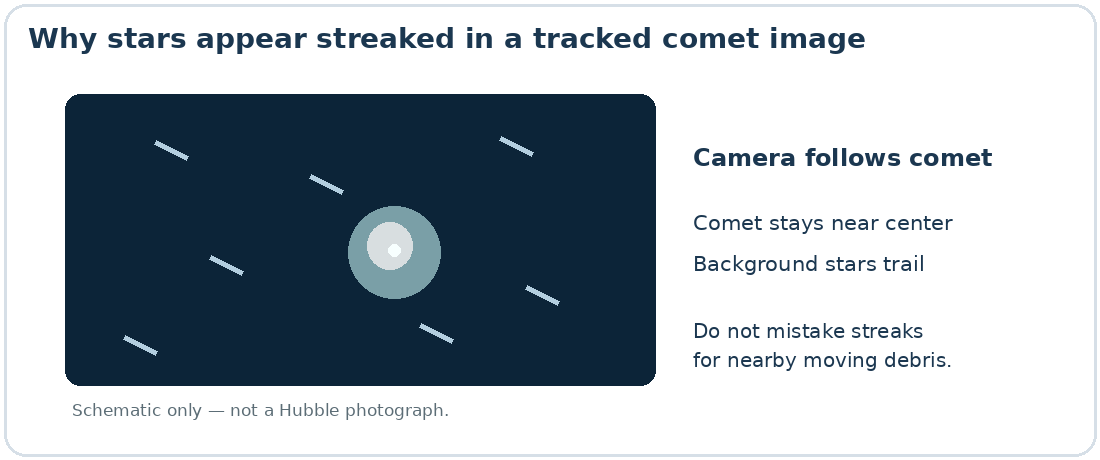
Original, simplified educational illustration; not to scale and not an observational photograph.
What changed in the November observation
NASA's official 3I/ATLAS image gallery records a follow-up Hubble observation on November 30, 2025. In that image the comet appears as a compact bright feature within a more extended halo. A different viewing geometry, distance, exposure, and level of activity can alter the visual impression without implying the object changed its underlying identity.
The two Hubble dates should not be conflated with the discovery: the ATLAS survey in Chile reported 3I/ATLAS on July 1, 2025. Nor should they be confused with images from other spacecraft near Mars. Each instrument records a different wavelength or perspective, and the captions provide the essential context.
Why the nucleus is not a sharply visible ball
A comet's nucleus is small compared with the dusty coma around it. Even a powerful telescope may measure the nucleus only indirectly, using the brightness and motion of the unresolved central region. NASA's later Hubble-based size constraints placed its diameter between roughly 440 meters and 5.6 kilometers, an interval rather than one directly photographed, exact measurement.
The blue tones in some released Hubble images are part of image processing and filter assignments. They help the viewer distinguish a faint feature against the sky; they are not necessarily what a human observer would see through an eyepiece.
How to credit a real image responsibly
Use the observation date, instrument, and full image attribution together. The July release credits NASA, ESA, David Jewitt (UCLA), and image processing by Joseph DePasquale (STScI). Before embedding a photograph in a commercial webpage, check the individual asset's reuse and credit instructions; a generic social-media repost is a poor source for provenance.
If an article needs a schematic rather than a licensed image, label it as a simplified illustration. A diagram can show the relation among nucleus, coma, tail, tracking direction, and background stars without pretending to reproduce Hubble data.
Frequently asked questions
Did Hubble prove that 3I/ATLAS is artificial?
No. The photographed coma and the published orbit are consistent with an active interstellar comet; the image alone provides no evidence of an engineered craft.
Why do the background stars look like lines?
Hubble tracked the comet, leaving stationary background stars streaked during the exposure.
Were both Hubble photos taken in 2026?
No. The key July 21 and November 30 observations were made in 2025.