3I/ATLAS Explained: The Interstellar Comet and 2026 Discoveries
What is 3I/ATLAS? See its confirmed origin, discovery, orbit and 2026 research findings—without alien-ship speculation.
3I/ATLAS Explained: The Interstellar Comet and 2026 Discoveries
3I/ATLAS is a natural comet that originated outside our solar system. Discovered on July 1, 2025, it became the third confirmed interstellar visitor after 1I/‘Oumuamua and 2I/Borisov. Its speed and open, hyperbolic trajectory—not an unusual photograph or a rumor—establish where it came from. By November 2026, astronomers have more than a year of observations and fresh chemical measurements to examine.
How astronomers identified an interstellar comet
The NASA-funded ATLAS survey in Chile reported the object to the Minor Planet Center on July 1, 2025. Scientists followed its position over time, calculated an orbit and found that it moved too fast to remain bound to the Sun. Ordinary comets can return in elliptical orbits; this visitor follows an unbound path and continues back toward interstellar space. Its name reflects that classification: 3 for the third recognized visitor, I for interstellar, and ATLAS for the discovery survey. The comet's other designation is C/2025 N1 (ATLAS).
What telescopes actually observed
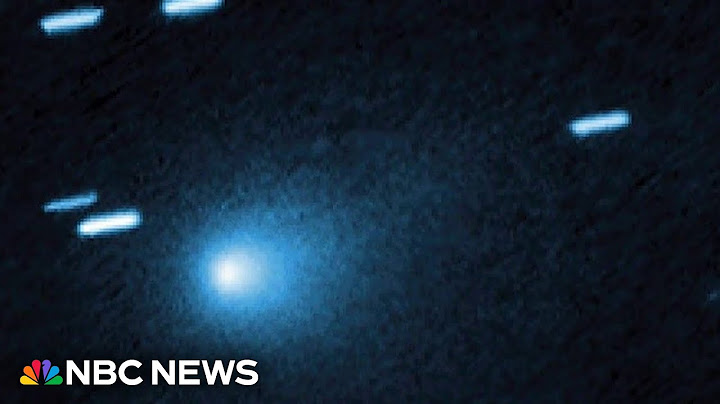
3I/ATLAS displayed a coma: gas and dust released as sunlight warmed an icy nucleus. That activity makes it a comet rather than a bare asteroid. Hubble observations placed broad limits on the nucleus size, but the bright surrounding coma makes precise measurement difficult. It reached its closest point to the Sun in late October 2025 and passed safely far from Earth that December. Images show an astronomical target under specific observing conditions, not a detailed view of a spacecraft or machinery.
The significant 2026 discovery
Webb spectroscopy of material released from the comet revealed unusual hydrogen and carbon isotope ratios. A June 2026 study suggests that the object may have formed in an exceptionally cold environment in an ancient planetary system, potentially far older than the Sun. This is an interpretation of chemical evidence rather than a stopwatch measurement of the comet's age. Researchers can constrain plausible environments without locating a precise parent star or reconstructing billions of years of wandering through the galaxy.
What makes this visitor useful to science
Only a tiny number of interstellar objects have been detected. Each offers a chance to compare the chemistry and formation of other planetary systems with material from our own. ‘Oumuamua, found in 2017, was unusual and difficult to classify; 2I/Borisov, found in 2019, showed clear comet activity. The relative abundance of gases and isotopes in 3I/ATLAS expands the sample. It does not establish extraterrestrial technology, and disagreement over models should not be mistaken for evidence of a hidden threat.
A practical reading of the timeline
The discovery date, closest pass to the Sun and scientific publication dates describe separate events. On July 1, 2025 the object was reported; it reached perihelion in late October 2025; follow-up observations then supported a detailed June 2026 study. Researchers did not need to wait until 2026 to establish the interstellar orbit. The later work added chemistry and possible formation conditions. It is useful to distinguish direct evidence, such as observed spectral lines, from historical reconstructions that depend on a formation model. A well-labeled diagram of the actual trajectory is more informative than an unsourced depiction of the comet as a huge object near Earth.
Key takeaway
The value of 3I/ATLAS is scientific: a rare sample of material from another star-forming environment. Read the separate Earth-approach explanation for distance and safety details and the ExoMars image guide for the observing technique; neither requires repeating the entire discovery story.
Frequently asked questions
Is 3I/ATLAS an alien spacecraft?
No evidence supports that claim. Its observable coma, composition and trajectory fit a natural interstellar comet.
When was 3I/ATLAS discovered?
It was reported on July 1, 2025, by the NASA-supported ATLAS survey in Chile.
Will 3I/ATLAS return to Earth?
Its hyperbolic trajectory does not represent a repeating solar orbit; its closest Earth approach occurred in December 2025.