40 Eridani: The Real Triple-Star System Behind Fictional Vulcan
40 Eridani is a real nearby triple-star system, but the fictional planets Erid and Vulcan are not confirmed worlds.
40 Eridani: The Real Triple-Star System Behind Fictional Vulcan
40 Eridani is a real nearby triple-star system, also known by the name Keid, roughly 16 light-years from Earth. It has a special place in science fiction because Star Trek associated it with Vulcan. Real astronomy and fictional worlds are separate: the stars are observable, but a planet called Vulcan in that system has not been confirmed.
The three stars in the system
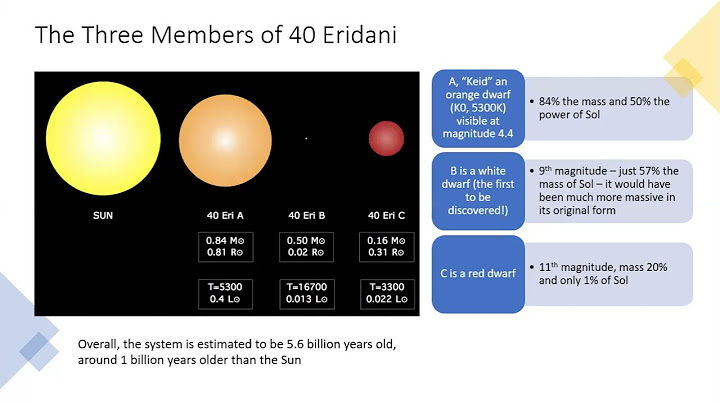
The bright primary, 40 Eridani A, is a K-type star that is cooler and somewhat less luminous than our Sun. Farther out is a companion pair consisting of a white dwarf, 40 Eridani B, and a faint red dwarf, 40 Eridani C. A white dwarf is a compact stellar remnant, not a still-burning Sun-like main-sequence star. This combination makes the system useful in education because several stages of stellar evolution appear in one nearby astronomical neighborhood.
Why science fiction uses the setting
Star Trek lore places the fictional planet Vulcan around 40 Eridani A, which gave fans a memorable real star to look up in a sky catalog. The novel and movie Project Hail Mary feature a different fictional world called Erid, and the similarity of names can easily cause confusion. A real star name used in a story does not demonstrate that the invented planet is real. Discussing the cultural link is useful when it is clearly distinguished from telescope measurements.
The proposed Vulcan exoplanet and its reassessment
A reported planet candidate around 40 Eridani A attracted attention partly because of its famous fictional association. However, later analysis found that stellar activity could produce the apparent radial-velocity variation, undermining the planet claim. A changing stellar spectrum can imitate the tiny wobble that astronomers use to search for exoplanets. This is why independent data, multiple observing methods and careful stellar-activity models matter before a candidate should be presented as a confirmed world.
What observers can actually learn
Distance, stellar type, orbital relationships and light spectra are all scientific properties that can be measured or modeled. The companion white dwarf helps researchers study how stars evolve after exhausting their core fuel, while the red dwarf illustrates a very different low-mass stellar population. None of this identifies atmospheric conditions on a nonexistent confirmed Vulcan. For a broader view of planetary systems, compare this individual triple star with estimates of planets around other Milky Way stars.
Why the exoplanet correction matters
Radial-velocity measurements search for tiny changes in a star's spectral lines. Planets can cause such changes, but rotating starspots and other stellar activity can also mimic periodic motion. Reexamining the proposed planet around 40 Eridani A showed why a familiar fictional name should not lead readers to accept a candidate prematurely. The correction is part of normal science: stronger data can overturn an exciting early interpretation. When discussing fictional Vulcan, it is better to give the star's real composition and distance than to invent the atmosphere or living conditions of a planet that has not been confirmed.
Key takeaway
A useful guide keeps the real stars, disputed exoplanet reports and literary settings clearly labeled.
Frequently asked questions
Is 40 Eridani real?
Yes. It is an observed nearby triple-star system.
Is Star Trek's Vulcan planet real?
No confirmed Vulcan planet has been established in that system.
Is Erid from Project Hail Mary an actual planet?
No. Erid is fictional, even though stories can refer to real astronomical ideas.