What Is Bremsstrahlung (Braking Radiation)?
Understand why accelerating or decelerating charged particles emit bremsstrahlung and how it differs from characteristic X-rays.
What Is Bremsstrahlung (Braking Radiation)?
SCIENCE EXPLAINED • US ENGLISH • EDITORIAL SNAPSHOT: NOVEMBER 1, 2026
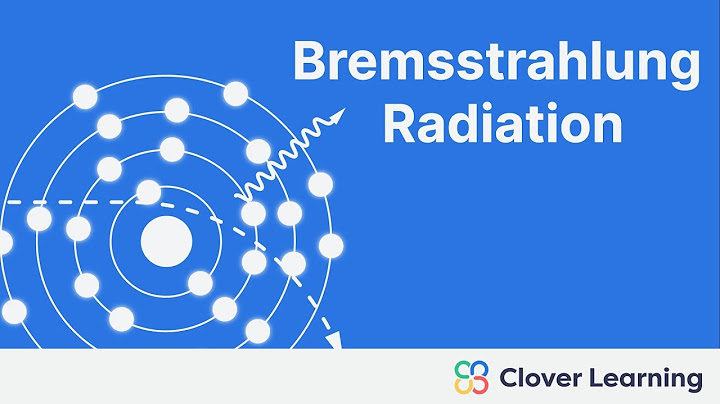
Bremsstrahlung, a German word for 'braking radiation,' is electromagnetic radiation emitted when a charged particle changes velocity under the influence of an electric field, often when an electron passes near an atomic nucleus. In many practical settings it produces X-rays. The term describes a radiation-generation mechanism, not a special radioactive substance or an alternative name for every gamma ray.
Why an accelerating charge can radiate
In classical electromagnetism, changing the velocity of an electric charge can produce electromagnetic radiation. Acceleration includes changes in direction as well as changes in speed. An electron passing near a positively charged nucleus can be deflected and slowed or sped along part of its path, exchanging energy with the electromagnetic field. Some of that energy may emerge as a photon.
A beginner sometimes imagines a particle slamming into a solid wall and 'sparking' like metal. That picture is too crude: bremsstrahlung often involves electromagnetic interactions between a charged particle and a nucleus, with no literal mechanical collision needed.
Why X-ray tubes can generate bremsstrahlung
In a conventional X-ray tube, electrons are accelerated toward a target. When they interact with the target material, some of their kinetic energy is converted into X-ray photons. The resulting bremsstrahlung spans a range of photon energies rather than a single spectral line. Much of the initial energy becomes heat, which is why real equipment requires specialized engineering and cooling.
The endpoint of the X-ray energy spectrum is constrained by the energy given to the electrons, but the distribution depends on the target and operating conditions. These details are handled by qualified equipment designers; they are not instructions for constructing a homemade source.
Bremsstrahlung versus characteristic X-rays
Bremsstrahlung produces a continuous spectrum because the electron can lose different fractions of energy in different interactions. Characteristic X-rays arise when an atom's inner electron vacancy is filled by an electron from a higher level, emitting a photon with an energy tied to the target element's atomic structure.
Both kinds of photons may appear in an X-ray tube spectrum. A single detected photon does not necessarily reveal its production history from wavelength alone. Understanding the mechanisms helps scientists interpret spectra and choose models for imaging and particle experiments.
Is bremsstrahlung a gamma ray?
The photon may lie within an energy range that overlaps what people informally call gamma-ray energies. Nevertheless, bremsstrahlung names radiation associated with accelerated charged particles, while nuclear gamma emission often names a nuclear transition. The classification depends on context and mechanism, not a neat universal wavelength boundary.
Bremsstrahlung can also matter in beta-radiation shielding. When energetic beta electrons are stopped in certain high-atomic-number materials, secondary X-rays may be produced. That is one reason radiation protection requires energy-specific assessments rather than a one-size-fits-all barrier.
Everyday relevance and limits
Medical diagnostic X-ray equipment and scientific accelerators provide familiar contexts for the process. It is also relevant to astrophysics and plasmas. The presence of the mechanism does not make ordinary electrical devices radioactive, and the word 'braking' does not imply frictional heating is the only way the radiation arises.
The continuous-spectrum clue
If one electron can surrender a different amount of energy during each interaction, the emitted photons can span a continuous range of energies. That is the conceptual fingerprint of bremsstrahlung. By contrast, atomic electron transitions between discrete energy levels create particular characteristic lines. The same observed X-ray spectrum can contain both a smooth background and lines, illustrating how different mechanisms work together.
Frequently asked questions
Why is it called braking radiation? Charged particles often emit photons as their motion changes near a nucleus, including a reduction of speed in some interactions.
Does bremsstrahlung make discrete or continuous X-ray energies? It typically produces a continuous range of photon energies.
Is it the same as radioactive decay? No. It can occur when charged particles are accelerated or deflected without an unstable nucleus decaying.
Explore related science topics
For a closer look at connected concepts, read gamma-ray fundamentals, and radioactive decay explained.