Carbonyl: Definition, Chemical Properties, Structure and Examples
Understand carbonyl with clear definitions, examples, scientific context, and notes on common misunderstandings.
Carbonyl: Definition, Chemical Properties, Structure and Examples
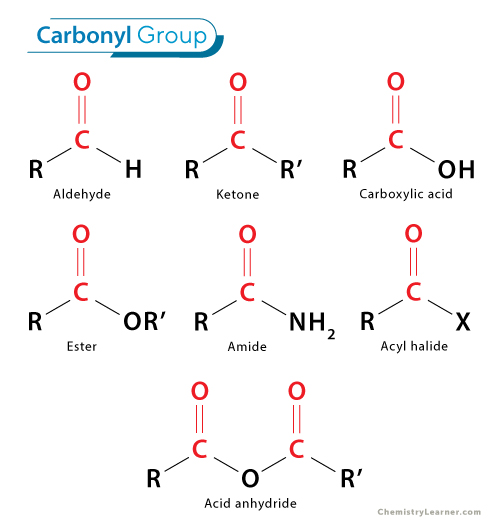
A carbonyl group consists of a carbon atom double-bonded to oxygen, written C=O. It is a defining feature of aldehydes, ketones, and several related functional groups.
A useful way to understand this topic is to separate the underlying idea from a worked example and from the limits of the explanation. Chemists ask what particles are present, how they interact, and which observations support a structural description. A chemical formula may be enough for composition but not for shape, solution behavior, or safe use.
How it works
The oxygen atom draws electron density, making the carbonyl bond polar and affecting reactions with nucleophiles and other reagents.
The mechanism matters because it explains the observation rather than just naming it. For accurate descriptions, the type of particles, bonds, or conditions involved should be stated explicitly.
An example in context
Acetone contains a ketone carbonyl, while acetic acid has a carbonyl as part of a carboxyl group. Their reactions differ because the neighboring atoms differ.
This example is best treated as a specific case, not an all-purpose rule. Compare the observed features with the underlying mechanism before applying the idea to another substance.
What the term should not be confused with
A carbonyl is a functional group rather than one specific chemical substance; its surroundings determine the larger compound's behavior.
These boundaries help keep this page focused. Related subjects may overlap, but a shared word or superficially similar appearance is not sufficient evidence that two concepts are equivalent.
Why the distinction matters
Reliable evidence may come from spectroscopy, controlled reactions, crystallography, or measured physical properties. A named chemical should be checked against its exact identity rather than inferred from a casual label.
For readers, the practical lesson is to ask what is directly observable, what is inferred from a model, and which further evidence would help separate competing explanations. In this topic, the example above illustrates why that difference can matter.
Common mistakes and limitations
Do not equate every carbonyl-containing substance with carbon monoxide or carbon dioxide. Names share a root but describe different structures.
The chemical properties of a pure substance do not automatically predict the effect of a consumer product. Concentration, impurities, and exposure are separate questions.
Frequently asked questions
What is Carbonyl? A carbonyl group consists of a carbon atom double-bonded to oxygen, written C=O.
What is a clear example? Acetone contains a ketone carbonyl, while acetic acid has a carbonyl as part of a carboxyl group.
What is a common misconception? A carbonyl is a functional group rather than one specific chemical substance; its surroundings determine the larger compound's behavior.
Continue exploring
A Clear Guide to Chemistry — a broader topic overview.
Noble Gases — a focused explanation of a related concept.
Trigonal Planar Geometry — a focused explanation of a related concept.
