Does Uranus Have a Solid Surface? What Is Inside the Ice Giant
Uranus does not have a solid landing surface. Here is what scientists know about its atmosphere, deep fluid layers and interior.
Does Uranus Have a Solid Surface? What Is Inside the Ice Giant
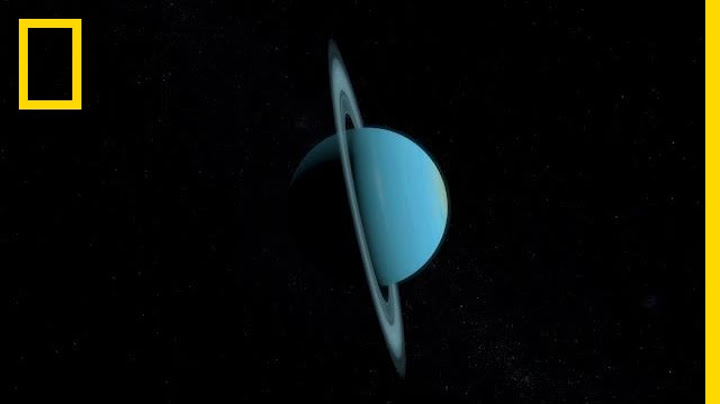
Uranus does not have a true solid surface like Earth, Mars or the Moon. Its visible outer layer is atmosphere, and the deeper materials become progressively denser under immense pressures. Scientists describe it as an ice giant, but that name does not mean a person could land on a frozen ocean or walk across a solid blue crust.
What lies beneath the blue-green clouds
Uranus's outer atmosphere contains mostly hydrogen and helium, with methane contributing to its color. Pressure and temperature increase as one moves down. The gases gradually transition toward denser fluid conditions, rather than ending at a sharply defined rock-and-soil boundary. Models suggest a substantial interior containing water-, ammonia- and methane-rich material under extreme conditions, and a deeper rocky component may be present. These are inferred layers, not a cross-section directly photographed by a spacecraft.
Why the word 'ice' can mislead
In planetary science, 'ices' refers to substances such as water, ammonia and methane that condensed in cold regions during the formation of planets. Deep inside Uranus, intense heat and pressure may keep those compounds in fluid or other exotic high-pressure states. The term is a compositional classification and contrasts with gas giants such as Jupiter and Saturn. It is not an assertion that the planetary interior resembles ordinary ice cubes floating beneath a familiar atmosphere.
What would happen to a descending probe?
A hypothetical spacecraft descending below Uranus's cloud tops would encounter increasing pressure, turbulent winds, changing temperatures and increasingly difficult conditions for instruments and materials. Without a solid ground surface to stop on, there is no straightforward landing procedure comparable with a Mars rover. At sufficient depth the environment would overwhelm a conventional probe. Any concept for exploring Uranus must instead consider orbiters, atmospheric probes or carefully limited descent missions.
What scientists know and still model
Voyager 2's 1986 flyby returned valuable atmospheric, magnetic and ring observations, but it did not directly probe the full interior. Planetary scientists combine remote measurements with laboratory physics and simulations to estimate the distribution of materials. The exact proportions and behavior of the deepest layers remain uncertain. Claims about a precise underground ocean or a solid diamond floor should be judged against the distinction between plausible high-pressure chemistry and direct observations.
Why diagrams show a boundary anyway
Educational cutaway drawings frequently show a blue atmosphere, a middle layer and a darker center. Those boundaries simplify complex transitions and competing interior models. They should not be read as a photograph of sharply separated solid shells. At extremely high pressure, fluids can behave in ways not encountered in ordinary Earth surface conditions. Estimates also depend on which equations of state scientists choose for mixtures of hydrogen, water, ammonia and methane. A useful caption calls the image an interior model or illustration so that schematic colors do not become mistaken for measured underground oceans or a firm landing platform.
Key takeaway
The meaningful way to describe the planet is through pressure, chemistry and interior models—not by assigning an Earth-like ground level that does not exist.
Frequently asked questions
Can humans land on Uranus?
No conventional landing is possible because Uranus lacks a solid surface and has extreme deep-atmosphere conditions.
Is Uranus made completely of gas?
No. It has a gas-rich outer atmosphere and a dense interior modeled with fluid and high-pressure materials.
Is the planet covered in ice?
Not in the everyday sense; 'ice giant' describes constituent materials and planetary formation.