What Is the Symbol for Gamma Radiation?
Understand the Greek gamma symbol, gamma-emission notation, and why the radiation hazard trefoil is not a gamma-ray-only symbol.
What Is the Symbol for Gamma Radiation?
SCIENCE EXPLAINED • US ENGLISH • EDITORIAL SNAPSHOT: NOVEMBER 1, 2026
The scientific symbol commonly used for gamma radiation is the lowercase Greek letter γ (gamma). In contrast, the familiar three-bladed radiation trefoil is a warning sign for ionizing-radiation hazards in general. They are not two interchangeable logos for gamma rays. Recognizing that difference prevents a frequent mistake in school diagrams, safety discussions, and online image searches.
The letter gamma in physics
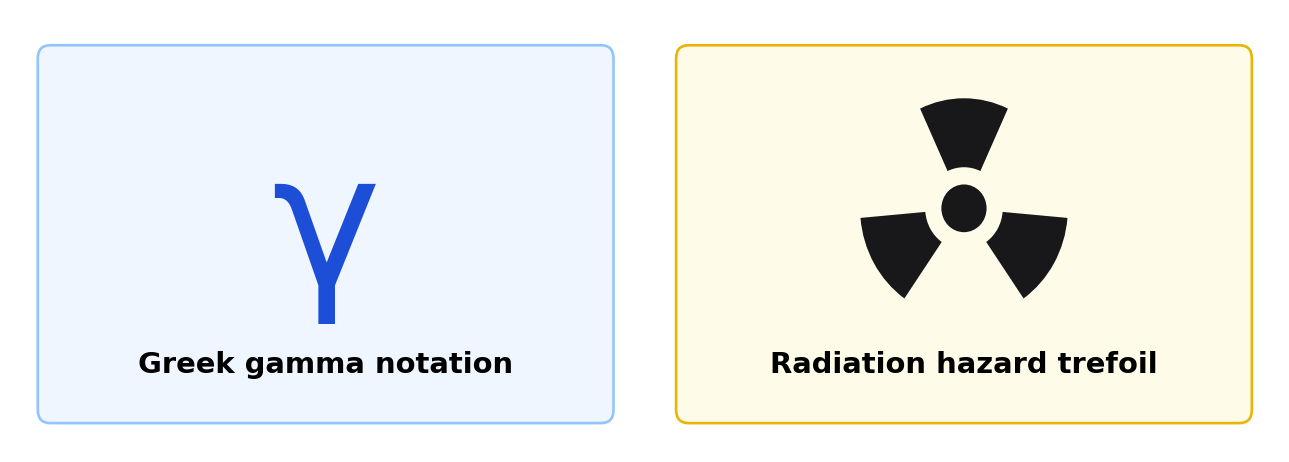
Original educational illustration (schematic; not to scale).
Greek letters serve as compact notation in mathematics and science. Physicists write γ when referring to gamma radiation or a gamma photon, especially in nuclear reaction descriptions. One illustrative schematic is X* → X + γ, where an excited nucleus X* loses energy by emitting a gamma photon. This shows a decrease in excitation, not a universal equation for every isotope.
In text and captions, 'gamma ray' describes the phenomenon, while γ provides a short label. The uppercase Greek Γ appears in other mathematical contexts, but the lowercase γ is the conventional symbol for gamma emission. A gamma photon has no charge; the label is not a sign for a third charged particle class.
What the trefoil actually warns about
The radiation trefoil has a central disk and three curved blades around it. In appropriate signs, it indicates the presence of an ionizing-radiation hazard or a controlled radiation area. It is not limited to gamma rays. A worksite might use the symbol because of X-rays, radioactive material, or other ionizing radiation as specified by applicable safety requirements.
The trefoil's shape and color conventions are governed by relevant standards and circumstances. A drawing in an educational article is explanatory; it must never replace the official signage required for a real facility. If you encounter an actual radiation warning, follow the site's safety directions rather than using an internet diagram to decide whether access is safe.
Why the two symbols are confused
Image searches for 'gamma radiation symbol' often return the hazard trefoil because gamma rays can be a source of ionizing-radiation exposure. But a label for a photon and a warning marking a hazard have different purposes. The Greek letter answers a notation question. The trefoil answers a workplace safety-identification question.
A school worksheet that asks for the Greek symbol usually expects γ. A question about the international radiation warning sign usually expects the trefoil. Read the wording before choosing an image or answer.
Nuclear notation in one example
A nucleus can be left in an excited state after another nuclear process. When that state relaxes, a photon may be emitted. Writing γ beside the emitted radiation communicates that it is electromagnetic energy rather than a helium nucleus (α) or electron/positron (β). Because exact nuclear equations depend on the nuclide and energy state, a simple schematic is the clearest general example for beginners.
Using symbols accessibly
In scientific diagrams, write out “gamma photon (γ)” at least once so readers unfamiliar with Greek letters understand the notation. For safety materials, do not rely on a decorative symbol with no words or context: formal labeling follows specific rules. This article includes an original educational comparison illustration, not a substitute for a legally required warning sign.
Frequently asked questions
Is gamma written as y? No. The Greek letter γ may resemble the Latin letter 'y' in some fonts, but they are different characters.
Does the trefoil mean gamma radiation specifically? No. It is a general ionizing-radiation hazard symbol.
Is gamma radiation positively or negatively charged? Neither. Gamma photons are electrically neutral.
Explore related science topics
For a closer look at connected concepts, read gamma-ray fundamentals, and examples of gamma-ray applications.