What Is the Interstellar Medium? Gas, Dust and Space Between Stars
The interstellar medium is the gas, dust and other material between stars. Learn what it contains and how stars form within it.
What Is the Interstellar Medium? Gas, Dust and Space Between Stars
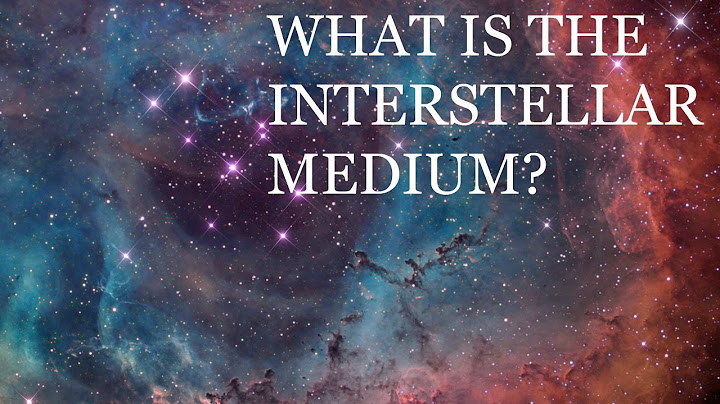
The interstellar medium, or ISM, is the material occupying the regions between stars within a galaxy. It is not truly empty: it contains gas, tiny solid dust grains, magnetic fields and energetic particles. Much of the gas is hydrogen, with helium and smaller amounts of other elements. The density is very low compared with air on Earth, yet the ISM plays a central role in the formation of new stars.
What fills the space between stars
In many regions, the interstellar medium contains isolated hydrogen atoms, ionized gas or molecules concentrated in colder clouds. Dust grains absorb and scatter some starlight and radiate energy at infrared wavelengths. A region can be extremely dilute by terrestrial standards while still containing enough material over light-years of distance to alter what telescopes observe. The ISM should not be confused with the solar wind environment immediately around one star or with empty space beyond a galaxy.
Why some regions are hot and others cold
Starlight, shock waves, stellar winds, supernovae and gravity continually disturb the gas. Hot ionized bubbles can coexist with cooler neutral regions, while dense molecular clouds shield their interiors from intense radiation. Different temperatures and densities produce distinct observational signatures in radio, optical, ultraviolet and infrared light. Astronomers use spectral lines and absorption features to map material that cannot be seen as an ordinary photograph of a solid object.
The connection to star and planet formation
Gravity can gather sufficiently dense clouds into collapsing structures. Under favorable conditions those clouds form protostars, disks and eventually planetary systems. Later, stars return processed material to the ISM through winds and explosions, enriching future generations with heavier elements. The interstellar medium is therefore not merely a backdrop; it participates in a cycle of star formation, stellar evolution and chemical recycling across the galaxy.
How interstellar objects move through it
Objects ejected from distant planetary systems travel through the broader galactic environment, interacting gravitationally with stars and passing through very thin interstellar material. A comet such as 3I/ATLAS can retain ancient ices while wandering through space for immense periods, but tracing it precisely to its birth system is difficult. Studying its chemistry provides indirect clues to formation conditions; that is different from measuring a continuous, known travel route through every interstellar cloud it encountered.
What a dark cloud tells astronomers
A region that looks opaque in visible light can glow in infrared or radio observations because cold dust and molecular gas emit at different wavelengths. By combining spectra with imaging, scientists estimate temperature, density and chemical content. Regions where stars are forming frequently contain dense molecular material, while supernova remnants can heat surrounding gas and reshape its distribution. These diverse states all belong to the interstellar medium. The most accurate mental picture is not a uniform thin fog but a changing collection of clouds, bubbles and diffuse material with very different local conditions.
Key takeaway
The ISM connects the life cycles of stars to the chemical ingredients of planetary systems across our galaxy.
Frequently asked questions
Is the interstellar medium a vacuum?
It is extremely dilute but contains gas, dust and charged particles.
What is interstellar dust made of?
Tiny solid grains containing materials such as silicates and carbon-rich compounds.
Why does the ISM matter?
It supplies raw material for new stars and planets and carries the products of older stars.