Ouranosaurus: Sail-Backed Dinosaur Anatomy and Fossils
Iguanodontian fossil evidence and debated tall neural spines function.
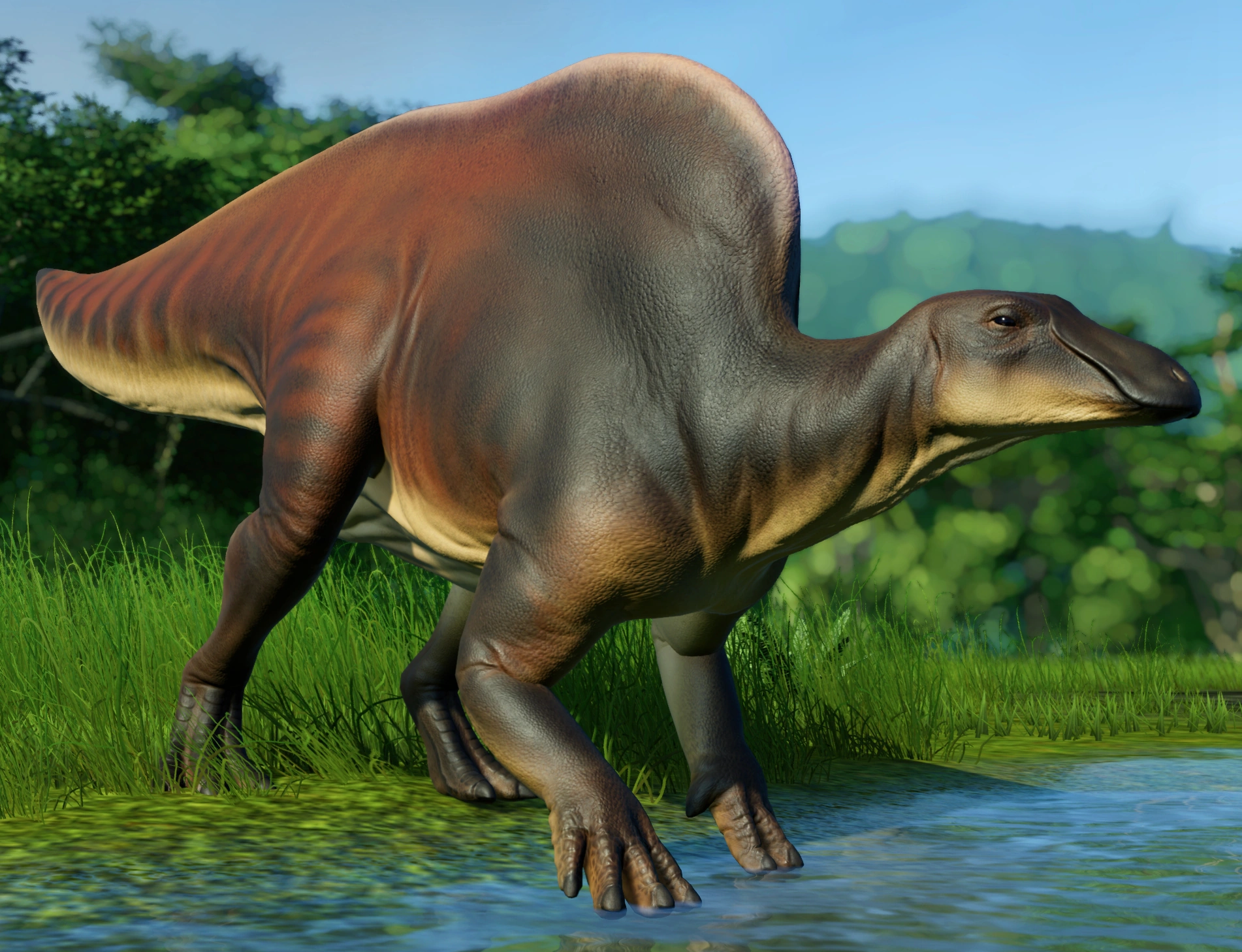
Ouranosaurus: Sail-Backed Dinosaur Anatomy and Fossils
Ouranosaurus was a plant-eating dinosaur from Early Cretaceous North Africa known for long neural spines along its back. The account below separates observations from fossil material and reasonable but uncertain reconstructions.
Identification and evolutionary relationships
Paleontologists identify fossil animals through diagnostic bones, not imagined colors or behaviors. Comparisons with related groups help reconstruct missing anatomy, but a fragmentary specimen sets real limits.
Geological age and fossil context
Fossils from Niger document environments influenced by rivers and seasonal conditions. The ancient landscape was not identical to the present Sahara.
A fossil formation supplies context about time and deposition, but it does not record every part of an ancient animal’s range.
Diet and ecological setting
Its beak and teeth are consistent with herbivory. Long back spines supported a raised structure, but whether it was a sail, hump or mixed tissue is debated.
Feeding claims are usually inferences from form and related evidence; detailed meal-by-meal statements are rarely justified.
Anatomy, movement and life history
Ouranosaurus had a broad muzzle and body features that distinguish it from later hadrosaurs. Its posture and movement are reconstructed from bone proportions.
Behavior is harder to reconstruct than bone structure. Where direct fossil evidence is scarce, cautious language is essential.
Evidence versus reconstruction
Taxonomy changes when new fossils or analyses appear. State which ideas are supported by physical specimens and which remain debated, especially for size, social behavior and reconstruction art.
Ouranosaurus differs from the much older synapsid Dimetrodon despite both being shown with raised back profiles. Similar silhouettes can arise in unrelated animals and from uncertain soft-tissue reconstructions.
What future discoveries could change
An identification rests on preserved anatomy and comparison, not the artist’s chosen pose or skin color. An illustration communicates one hypothesis. It should not be presented as a direct photograph of the past.
Reconstruction note: the soft tissues supported by the animal’s elongated back spines are not preserved clearly enough to establish one exact shape.
Treat fossil reconstructions as scientific models that can improve when new specimens are found.
Quick takeaways
Fossils from Niger document environments influenced by rivers and seasonal conditions.
Its beak and teeth are consistent with herbivory.
Pictures showing a precise sail shape or color are hypotheses, not fossil photographs.
Frequently asked questions
What was Ouranosaurus?
Ouranosaurus was a plant-eating dinosaur from Early Cretaceous North Africa known for long neural spines along its back.
Where and when do its fossils place it?
Fossils from Niger document environments influenced by rivers and seasonal conditions.
What can scientists say about its diet?
Its beak and teeth are consistent with herbivory.
