S&P 500 Sectors: The 11 GICS Groups Explained
Explore the 11 S&P 500 stock-market sectors, how GICS classification works, and why sector weights change over time.
S&P 500 Sectors: The 11 GICS Groups Explained
US INVESTING GUIDE • Methodology reviewed November 3, 2026 • Editorial draft
The S&P 500's companies are classified across 11 Global Industry Classification Standard (GICS) sectors. The sectors organize businesses by their primary activity, but they are not equally weighted in the standard S&P 500. Large companies and changing share prices drive each sector's share of the index. Knowing the sector definitions is more reliable than repeating an undated chart of percentage weights.
Why there are 11 S&P 500 sectors
GICS is a classification framework developed by S&P Dow Jones Indices and MSCI. Its top-level sector groups organize companies into industries, and industries into more detailed categories. Each constituent is assigned classifications according to defined rules. A sector name is therefore a category label, not a prediction of investment return or an assessment that all companies in that sector behave alike. The structure contains 11 sectors: Communication Services, Consumer Discretionary, Consumer Staples, Energy, Financials, Health Care, Industrials, Information Technology, Materials, Real Estate and Utilities. Industry classifications can be reviewed and revised, so a company's historical category is not necessarily permanent.
A sector ETF, meanwhile, is a separate product based on an investable sector benchmark.
| GICS sector | Representative business activities |
| Information Technology | Software, semiconductors, hardware |
| Communication Services | Telecom, media, entertainment |
| Consumer Discretionary | Vehicles, leisure, discretionary retail |
| Consumer Staples | Food, household necessities |
| Health Care | Medical services, pharmaceuticals, devices |
| Financials | Banks, insurance, exchanges |
| Industrials | Capital goods, transportation, professional services |
| Energy | Oil, gas, related equipment |
| Materials | Chemicals, metals, mining, packaging |
| Utilities | Electric, gas, water utilities |
| Real Estate | Property operators, equity REITs |
Technology, communication and consumer sectors
Information Technology includes areas such as software, semiconductors, hardware and IT services. Communication Services covers telecommunications and media and entertainment, including many digital content activities. They are different categories even when both contain companies commonly described as “tech” in everyday speech. Consumer Discretionary groups activity more sensitive to consumer cycles, including automobiles and certain retail and leisure businesses. Consumer Staples instead includes products considered recurring necessities, such as food, beverages and household essentials. The classification does not promise that staples stocks always outperform in recessions. Company valuation, margins, regulation and unexpected events can influence any sector. Investors should not equate an industry label with low volatility.
Financial, industrial and health-related activity
Financials contains banking, insurance, exchanges, financial services and related activities under GICS rules. Industrials includes capital goods, transportation and commercial and professional services. Health Care includes pharmaceuticals, biotechnology, medical devices and health-related services. These are broad umbrellas with businesses that face very different demand cycles and regulatory risks. For example, an aircraft manufacturer and a professional staffing company can both fall under Industrials. A drug-development company and a hospital operator both sit within Health Care while having distinct research and operating risks. That is one reason a sector's aggregate return does not tell the full story of every constituent.
Energy, materials, utilities and real estate
Energy covers oil, gas, related production and equipment activities. Materials includes chemicals, construction materials, metals, mining and packaging. Utilities encompasses essential energy and water services as well as relevant power generation businesses. Real Estate contains specified real-estate operating and development companies, including equity REITs in the classification framework. These sectors can respond differently to interest rates, commodity prices and economic demand. But those tendencies are not fixed rules. Corporate strategy and sector-specific shocks can matter more than a simplistic claim that a rising commodity price helps every business in a category.
How sector weights change
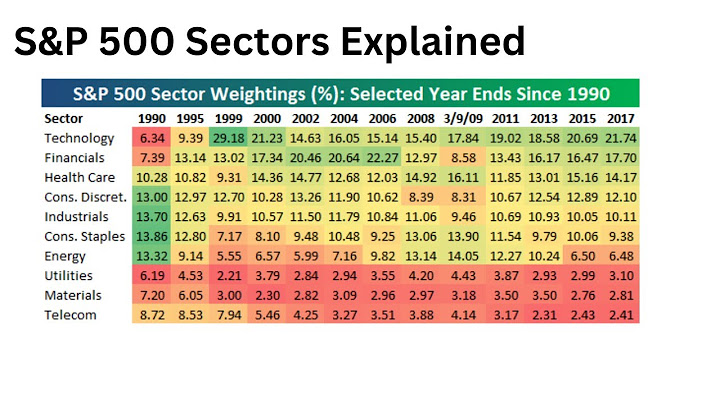
The standard S&P 500 is weighted by float-adjusted market capitalization. Sector weight is effectively the combined index weight of its constituent companies. If a major company rises faster than others, its sector's share may increase even without a change in the companies included. Constituent additions, removals and reclassifications can also change the mix. A current sector-weights table requires a dated official index fact sheet or reliable licensed market data. Reposting percentages without their date misleads readers about concentration. A static reference article can safely explain sector definitions while withholding percentages until their source and timestamp can be displayed.
Sector diversification has limits
Holding a standard S&P 500 fund provides multiple sectors, but it does not guarantee equal exposure. Factor risks can cut across classifications—for instance, many companies may depend on low interest rates or similar consumer behavior. Compare sector concentration with broad-market, equal-weight and specialized products only after understanding that they address different investment questions. The classification also differs from a stock-market heatmap. A heatmap visualizes prices or performance over a selected period and needs current data; a sector guide explains how industries are grouped. This page is about the classification and the logic of weights, not a live trading dashboard.
Why sector labels can surprise readers
Some widely recognized online platforms may belong to Communication Services rather than Information Technology, while some payment or financial technology businesses fall under Financials. A company's marketing language does not determine GICS classification. Classification changes occasionally occur as industry structure changes. Always consult the current GICS description before calling a business “tech sector” solely because its product uses software. For historical sector analyses, obtain classifications valid during the historical period rather than retroactively assuming today's groups applied in the same way.
Reading a sector concentration report
A proper table shows the date, index version, each sector's percentage and any relevant rounding rules. The weights should add to roughly 100%, allowing for rounding. Look beyond the largest sector: the top ten stocks may still create concentration within several groups. When comparing two sector reports, differences may reflect price changes, reconstitution or different index variants. A portfolio that intentionally holds each sector equally is not the same as the ordinary market-cap-weighted benchmark.
Frequently asked questions
How many sectors are in the S&P 500?
There are 11 top-level GICS sectors.
Is technology always the biggest sector?
Its weight depends on constituent market values and can change; check a dated source rather than assuming a fixed ranking.
Are sectors weighted equally?
No. The standard index uses float-adjusted market capitalization weighting.
What is the difference between a sector and an industry?
An industry is a more detailed classification within a broader sector.
Does buying an S&P 500 fund give equal sector exposure?
No. Sector allocations reflect constituent weights, not an 11-way equal split.
Related guides
• SPX 500 Explained: What the S&P 500 Index Measures
• S&P 500 Equal Weight vs. Market Cap Weight: Key Differences