Plants in Temperate Deciduous Forests: Layers and Seasonal Adaptations
Canopy trees, understory, spring ephemerals, light/season.
Plants in Temperate Deciduous Forests: Layers and Seasonal Adaptations
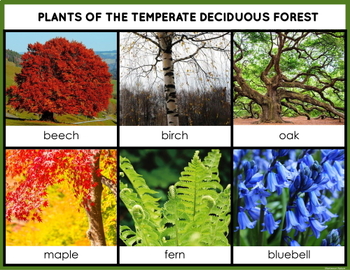
Temperate deciduous forests include trees that shed leaves seasonally, alongside shrubs, herbs, mosses and fungi-associated plants. The key is a precise definition supported by examples that do not confuse related concepts.
Meaning and key distinctions
Definitions matter because everyday terms can cover different scientific mechanisms. Start with what is being classified, then ask what evidence would make one interpretation preferable to another.
Where the concept applies
The canopy shades the understory during summer, while early spring sunlight supports many short-lived wildflowers. Soil moisture and slope shape plant distribution.
Ecological processes can look different when researchers change the geographic or time scale being studied.
How it works in an ecosystem
Trees use sunlight to build organic matter, supplying leaves, seeds and wood to the food web. Fallen leaves feed soil organisms and recycle nutrients.
Real ecosystems are networks with feedback loops. Changes in one part can alter several others.
Examples and changing conditions
Leaf fall reduces winter water loss for many trees. Flowering and seed production track seasonal signals and local climate.
Mechanisms need to be distinguished from outcomes. Similar-looking outcomes can arise for different reasons.
Common misconceptions
A useful explanation distinguishes direct observation from interpretation. For classroom answers, clearly state the definitions being used rather than treating ambiguous classifications as universal truths.
Canopy trees and spring ephemerals use light at different times of year. This contrast explains why the forest floor can be bright and flower-rich before the leaf canopy closes.
How to use the term accurately
A clear definition is the first step; a good example then shows where the boundary of that definition lies. Scientific terms are useful only when assumptions are stated and examples match those assumptions.
When checking an example, name the organisms and conditions involved rather than relying only on a textbook diagram.
Quick takeaways
The canopy shades the understory during summer, while early spring sunlight supports many short-lived wildflowers.
Trees use sunlight to build organic matter, supplying leaves, seeds and wood to the food web.
The forest is not made only of broadleaf trees; conifers and other vegetation may occur.
Frequently asked questions
Which plants grow in temperate deciduous forests?
Temperate deciduous forests include trees that shed leaves seasonally, alongside shrubs, herbs, mosses and fungi-associated plants.
Where can the idea be applied?
The canopy shades the understory during summer, while early spring sunlight supports many short-lived wildflowers.
What is an important limitation?
The forest is not made only of broadleaf trees; conifers and other vegetation may occur.
