The Tunguska Event: What Happened in Siberia in 1908?
What caused the Tunguska explosion in 1908? Explore the likely airburst, tree damage and evidence scientists still study.
The Tunguska Event: What Happened in Siberia in 1908?
On June 30, 1908, an enormous explosion over a remote region of Siberia flattened forest near the Podkamennaya Tunguska River. The leading explanation is an incoming cosmic object that broke apart in the atmosphere, releasing its energy before it could carve a conventional impact crater. The Tunguska event remains one of the clearest reminders that dangerous small bodies do not need to strike the ground intact.
What witnesses and researchers found
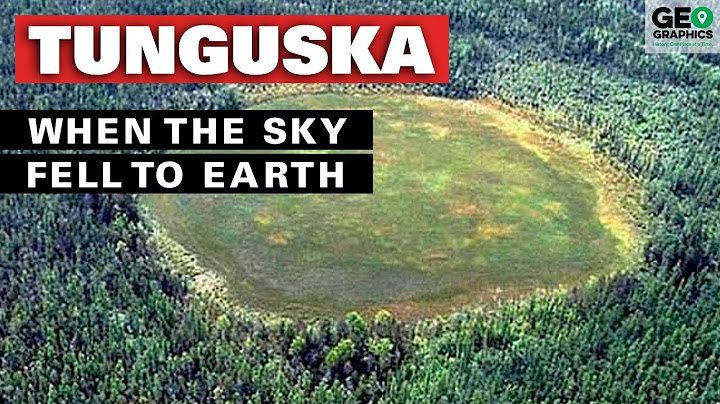
People reported a fireball, a powerful shock wave and shaking over a broad area. Later field expeditions documented vast stretches of damaged and fallen trees, generally radiating outward from an affected zone. The delay between the explosion and the first major scientific surveys meant that investigators had to reconstruct the event from testimony, tree patterns and physical traces. Estimates of the energy and the exact object's composition depend on the reconstruction model, so suspiciously precise figures should be treated cautiously.
An airburst rather than a classic impact crater
When a fast-moving rocky or icy object encounters Earth's atmosphere, pressure and heating can fracture it. If most energy is released aloft, the shock wave can strike the forest without a single large surviving object striking the ground. That scenario explains why researchers did not find an obvious crater at Tunguska. It does not require the object to be a spacecraft, weapon or exotic natural phenomenon. Debate remains about parameters such as altitude, incoming direction and whether the original body was mostly rocky or comet-like.
How the evidence compares with Chelyabinsk
The 2013 Chelyabinsk meteor over Russia offers a modern airburst example, recorded by cameras and instruments rather than reconstructed decades later. Its shock wave damaged windows and injured people, demonstrating the hazard even without a huge crater. Tunguska was much more destructive across the forest, but the events are not identical in energy or observational detail. Researchers use newer airburst physics to test models of the historical blast, not to imply that all approaching asteroids behave exactly alike.
What Tunguska teaches about planetary defense
Modern asteroid surveys track near-Earth objects, while atmospheric monitoring and laboratory studies improve understanding of fragmentation. The Tunguska case illustrates a risk category between frequent small meteors and rare enormous impacts: a sizable airburst can cause regional damage. No single historical theory eliminates all uncertainty, yet the mainstream explanation rests on ordinary impact physics. The useful question is how well scientists can detect incoming objects and estimate where an airburst could occur.
Why early observations require care
The event occurred far from major population centers, and the first systematic expeditions arrived years later. That means some widely repeated descriptions rely on later recollections or estimates rather than direct instrument records from 1908. Researchers have reconstructed blast direction and energy by combining the surviving forest pattern with physical models. These uncertainties do not make the entire event mysterious; they simply mean its details cannot be measured as precisely as those of a modern, instrument-recorded meteor. The responsible approach is to report a strong atmospheric-impact explanation while keeping disputed numbers and competing models clearly labeled.
Key takeaway
The distinction between an airburst and a ground impact is central to understanding Tunguska. Sensational stories are not a substitute for the damaged-forest pattern and physical modeling.
Frequently asked questions
What caused the Tunguska explosion?
Most researchers attribute it to a cosmic object breaking up and releasing energy in the atmosphere.
Where is the Tunguska crater?
No widely accepted large impact crater has been identified; an atmospheric airburst explains that absence.
Was Tunguska caused by aliens?
No reliable evidence supports an alien explanation for the 1908 event.