Which Planet Spins on Its Side? Uranus and Its Extreme Tilt
Uranus rotates nearly on its side. Learn its 97.8-degree tilt, unusual seasons and possible ancient collision.
Which Planet Spins on Its Side? Uranus and Its Extreme Tilt
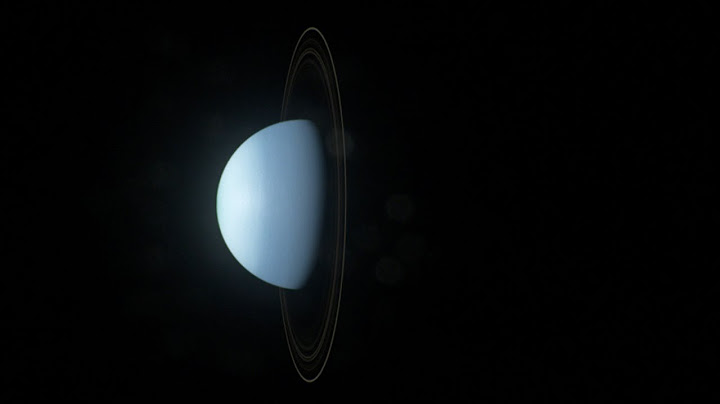
Uranus is the planet that famously spins on its side. Its rotational axis is inclined about 97.77 degrees to the plane of its orbit, a much greater tilt than Earth's. The result is an extraordinary seasonal pattern in which the Sun can shine toward one pole for years while the opposite region experiences prolonged darkness.
What a 97.77-degree tilt means
Planetary axial tilt describes the angle between the rotation axis and the direction perpendicular to the orbit. Earth's tilt is about 23.4 degrees, enough to produce familiar seasons; Uranus's is close to a quarter-turn. It therefore appears to roll around the Sun as it rotates. Its equator is nearly perpendicular to its orbital plane. That sideways geometry is more important to its seasons than the simple fact that Uranus is far away and cold.
Days, years and extreme seasons
Uranus rotates once in roughly 17 hours but needs about 84 Earth years to complete an orbit. A Uranian quarter-year lasts roughly 21 Earth years. Near certain points of the orbit, one pole receives prolonged sunlight while the other endures darkness. As the planet moves onward, the illuminated hemisphere changes. The atmosphere reacts to this slow seasonal forcing, although scientists are still investigating why some observed cloud and temperature patterns are more complicated than a simple tilted-globe diagram suggests.
Why scientists suspect an ancient collision
A collision with a large planetary embryo early in Uranus's history could have tilted the axis dramatically. However, researchers also examine gravitational interactions and other possible evolutionary pathways. No one has observed the original event, and the planet's moon system, rotation and interior each impose constraints on proposed models. It is accurate to say that a giant impact is a leading idea, not that scientists have recovered the impactor or know the exact day that Uranus tipped over.
How Uranus compares with Venus
Venus also has an unusual rotation, turning slowly in a retrograde direction compared with most planets. Yet Venus does not experience Uranus's distinctive sideways polar geometry. Rotation direction and axial tilt are related but different concepts; either can be described using the orientation of the planet's spin. Calling Uranus the 'sideways planet' explains an observable geometric fact, rather than claiming that its orbit travels vertically through space.
How to visualize the geometry
Imagine placing a small ball on a table and tilting the axis until its poles point almost along the orbital plane. Now move that ball around a lamp while allowing it to rotate. The illuminated pole changes over the long orbit, unlike Earth's more modest seasonal tilt. This simple classroom model communicates the geometry better than saying that Uranus 'falls over' or physically changes its axis every season. The axis remains tilted as the planet moves; its orientation relative to incoming sunlight changes. That distinction is important when comparing seasonal illumination with weather patterns caused by atmospheric circulation.
Key takeaway
The extreme tilt creates the seasonal behavior, while its exact cause remains a question for planetary formation models.
Frequently asked questions
Which planet rotates on its side?
Uranus, with an axial tilt of approximately 97.77 degrees.
How long is a Uranus year?
About 84 Earth years.
Was Uranus tipped over by another planet?
An ancient large collision is a plausible hypothesis, not a directly confirmed event.