What Is the Cherenkov Radiation Effect?
Explore why charged particles produce a blue glow when moving through a medium faster than light travels through that medium.
What Is the Cherenkov Radiation Effect?
SCIENCE EXPLAINED • US ENGLISH • EDITORIAL SNAPSHOT: NOVEMBER 1, 2026
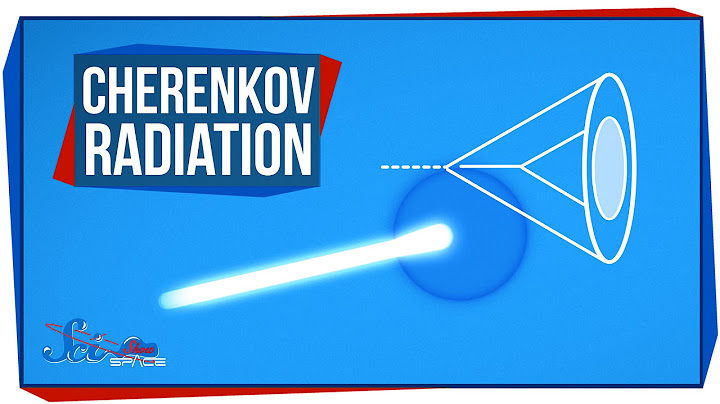
Cherenkov radiation is light emitted when a charged particle moves through a transparent medium faster than light's phase velocity in that medium. It is responsible for the striking blue glow often photographed in water around certain nuclear facilities. It does not mean a particle has broken Einstein's vacuum speed limit: the relevant comparison is with light traveling through water or another material, not with light in empty space.
The crucial speed distinction
Light travels at speed c in vacuum, but its phase velocity in a medium with refractive index n is approximately c/n at a given frequency. A sufficiently energetic charged particle can move faster than that reduced phase velocity while remaining slower than c. Under those conditions, its electromagnetic interaction with the medium can produce coherent light emission at a characteristic angle.
This is sometimes compared to a sonic boom, because a moving source outruns the local propagation speed of a wave in its medium. The analogy is useful, but the processes are not identical. Cherenkov light depends on particle charge, speed, refractive properties, and the wavelengths involved.
Why the glow is often blue
The emitted spectrum and how light travels through the material together affect what the human eye sees. Shorter visible wavelengths are often prominent, making the light look blue or bluish-violet in water. The exact apparent color depends on the medium, observation geometry, optical absorption, and detector or camera response.
A photograph of blue light alone does not prove nuclear material is present. Many ordinary physical processes make blue light. Cherenkov radiation is identified from its specific conditions and properties, not color by itself.
Where Cherenkov radiation appears
Water-filled reactor pools can show Cherenkov light from energetic charged particles produced by interactions involving radioactive materials. Particle-physics detectors use transparent media to record light rings or cones and infer properties of passing particles. Astrophysical observatories also exploit Cherenkov-related effects in air or specialized detector materials.
Detection systems analyze more than brightness: timing, angles, and the number of recorded photons can help identify the motion and energy of particles. A detector's design is highly specific to the particle species and measurement goal.
Is it the same as gamma radiation?
No. Gamma rays are high-energy photons; Cherenkov radiation is an emission process associated with fast charged particles passing through a medium. Gamma rays can sometimes create energetic secondary charged particles through interactions, which may then emit Cherenkov light if conditions permit. But calling the blue glow 'gamma rays made visible' skips an important intermediate process.
It is also different from the glow inside a decorative plasma globe. Plasma globes use electrical discharges in low-pressure gas, not a stream of particles outrunning light's phase velocity through a transparent liquid.
What Cherenkov light cannot tell you alone
An attractive blue glow is not a radiation-safety assessment. The brightness visible to a person says little by itself about ambient dose, shielding, or whether access is safe. Professional facilities follow calibrated radiation protection systems; none of their controls should be inferred from photographs.
The threshold explained without a paradox
Suppose light’s phase velocity in a transparent medium is roughly three-quarters of c. A charged particle moving at 0.9c is still slower than light in vacuum, yet it can exceed the wave’s phase velocity in that material. Cherenkov emission is therefore compatible with relativity. The exact threshold depends on the refractive index at the relevant frequency and the particle’s speed.
Frequently asked questions
Does Cherenkov radiation violate relativity? No. The charged particle does not exceed light's speed in vacuum.
Can Cherenkov radiation occur outside water? Yes. It can occur in other suitable transparent media when the speed condition is met.
Why is there a cone of light? The emission has a characteristic direction related to particle speed and the medium's refractive index.
Explore related science topics
For a closer look at connected concepts, read gamma-ray fundamentals, and alpha, beta, and gamma compared.