Core Civic Concepts: Sovereignty, Government, Constitutionalism and Political Systems
Explore civics and political concepts with carefully defined concepts, evidence-led examples and focused guides to individual questions.
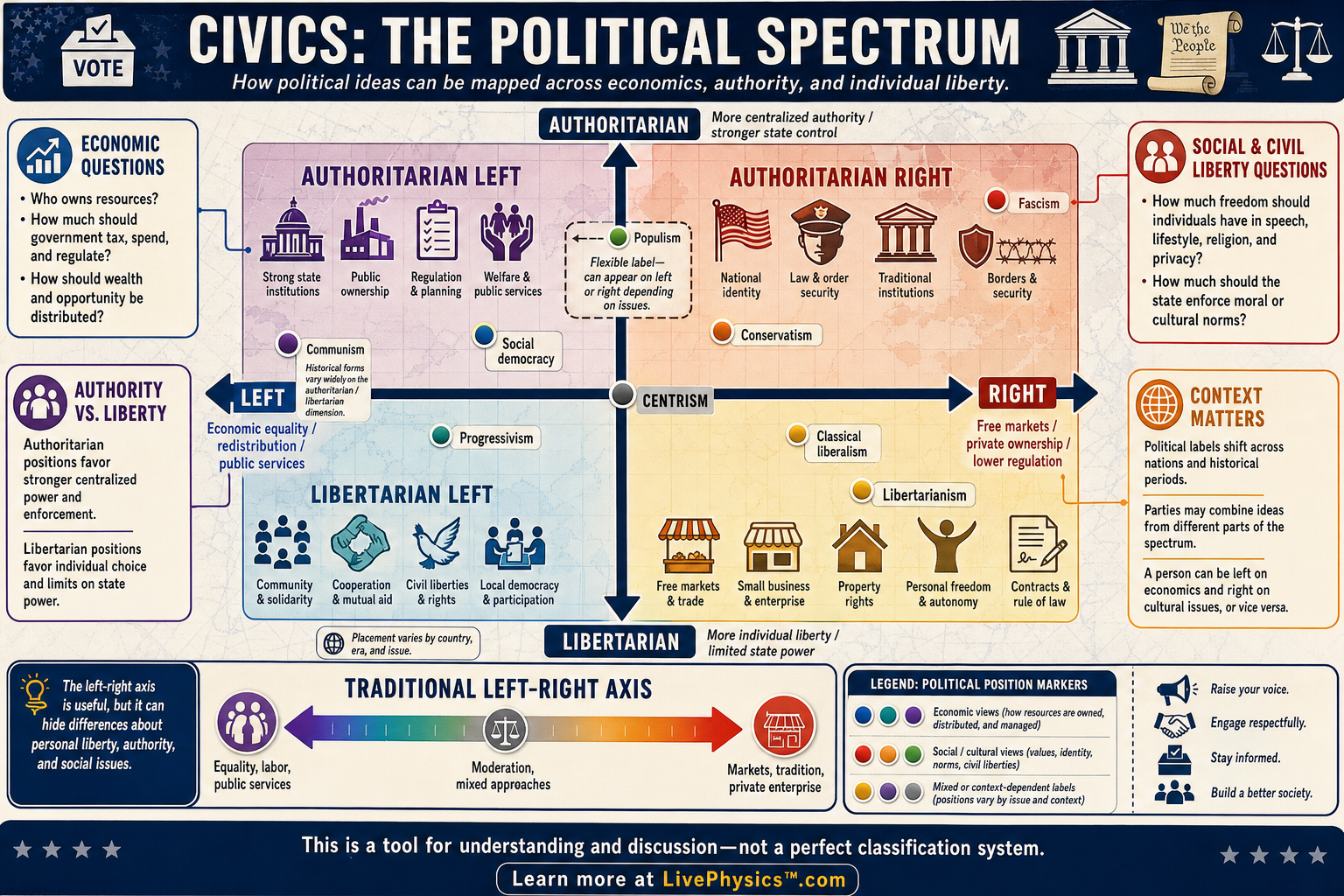
Core Civic Concepts: Sovereignty, Government, Constitutionalism and Political Systems
Civics examines how political authority is justified, organized, and constrained. Historical institutions and modern laws use familiar words in different ways, so definition and context must stay together.
How the field is organized
Popular sovereignty asks where legitimate authority originates; constitutionalism addresses limits on how that authority is exercised. Sectionalism describes regional political divisions, while trade embargoes are policy instruments.
Core ideas and how to read them
Corporate and governmental institutions also change through history. Joint-stock ownership helped pool resources for large undertakings, but ownership structures and legal protections have varied.
Civic concepts must be interpreted against their historical and legal setting. A word can describe an ideal, an institution, or a particular policy depending on context.
Explore the topic library
Popular Sovereignty — Popular sovereignty is the principle that ultimate political authority originates with the people rather than an inherited ruler or an institution claiming independent legitimacy.
Sectionalism — Sectionalism is strong identification with and loyalty to the interests of a particular geographic region within a larger country.
Embargo — An embargo is an official restriction that prevents or limits specified trade, shipments, or other transactions with a country or group.
Joint-Stock Companies — A joint-stock company raises capital by dividing ownership into shares held by investors.
Constitutionalism — Constitutionalism is the idea that government power should operate under fundamental rules and meaningful legal restraints.
How explanations are evaluated
Distinguish the general concept from current law and political judgment. The meaning of an embargo, for example, depends on the exact restrictions, exemptions, and jurisdiction at a particular moment.
Constitutional texts, legislation, historical documents, and political scholarship provide different forms of evidence. Current applications may require checking amendments and recent rules.
Questions worth asking
What exactly is being defined? Which mechanisms have been established, and which statements describe simplified models? How does the evidence change when time, location, scale, or context changes?
Use the linked articles for the detailed definitions, examples, and limits. This page is a directory and overview rather than a replacement for the individual subject entries.
