A Halloween History Timeline: From Early Customs to Today
Follow the history of Halloween from early autumn traditions to modern American costumes, trick-or-treating and celebrations.
A Halloween History Timeline: From Early Customs to Today
Halloween did not appear all at once with pumpkins and plastic skeletons. Its modern form emerged through changes in religion, seasonal culture, immigration, neighborhood life and entertainment. The timeline below follows broad developments without pretending historians can assign an exact birthday to every custom.
Early Autumn Traditions
Before today’s commercial holiday, communities in parts of the British Isles marked the transition into the darker part of the year. Samhain is often mentioned in discussions of Gaelic seasonal traditions. Surviving accounts were recorded in different periods, so it is important not to project every modern Halloween image backward into ancient history.
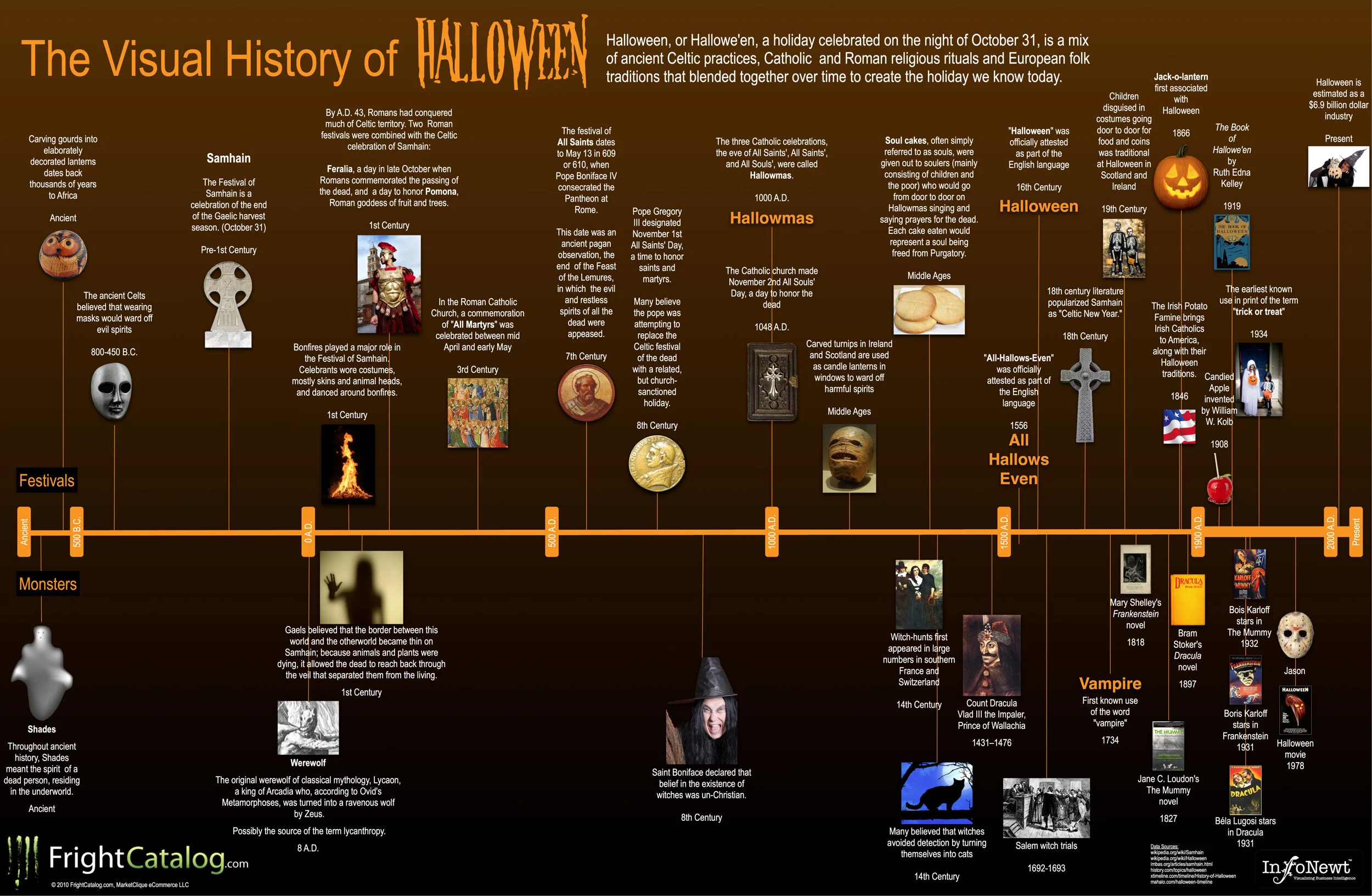
When creating a timeline display, give each era a distinct question. For early seasonal customs: how did communities mark the changing year? For religious observances: how did the name develop? For immigration: which practices traveled and changed? For twentieth-century celebrations: why did neighborhoods become central? For modern Halloween: how do films and businesses affect the shared imagery? Each answer should be modest and specific. Avoid drawing a straight line from one ancient story to every modern behavior. If a picture, costume or candy tradition is hard to date confidently, describe it as a later development rather than inventing a precise origin.
All Hallows Eve
All Hallows Eve is associated with the Christian calendar and the eve of All Saints Day. Over time, European communities practiced different visiting, masking and food-related customs around the season. These practices were neither identical across regions nor a single unchanged ritual. The holiday’s name reflects one part of its layered development.
An effective timeline can be presented as five broad cards rather than dozens of precise years: seasonal observations in parts of Europe; Christian calendar associations; customs brought into North America; the growth of community Halloween celebrations; and contemporary media-driven festivities. This gives readers a useful mental model without suggesting that scholars can document an unbroken chain of identical practices over two millennia.
How Customs Reached America
Immigration helped bring familiar autumn and seasonal customs to North America, where they encountered new foods, neighborhoods and social practices. Pumpkin carving became prominent partly because pumpkins were well suited to lantern-making. Community parties and local celebrations took different shapes in urban and rural settings.
Costumes and Trick-or-Treating
In the late nineteenth and early twentieth centuries, organized parties, costumes and neighborhood activities became more visible. The modern trick-or-treating routine expanded significantly in the twentieth century. Large candy manufacturers, retailers, television and movies helped make recognizable images and seasonal products part of the shared experience.
Modern Halloween Milestones
By the late twentieth and early twenty-first centuries, Halloween included themed attractions, online trends, professional makeup, community events and elaborate home displays. Today a celebration may be a school parade, a horror-movie marathon or a front-porch candy bowl. The variety itself is a feature of Halloween’s history, not a departure from one rigid tradition.
When writing captions for historical photographs, date the object and place instead of presenting the image as proof of the entire holiday. A community parade photographed in the 1920s documents one event; it cannot establish what happened nationwide. Apply the same care to reminiscences about masks, lanterns and pranks. Regional variation is part of the history and makes the story richer, not weaker.
A useful way to apply these ideas
Make one small version first, then adjust it for your audience, space and resources. The following checks are specific to this topic; use them as a short planning pass instead of assuming every example fits every situation.
Practical takeaways
Use broad eras when the exact year of a custom is disputed.
Label modern entertainment traditions separately from folklore.
Discuss immigration and twentieth-century neighborhood changes.
Avoid turning uncertain origin stories into absolute statements.
When did trick-or-treating become common in the US? Its familiar door-to-door form expanded during the twentieth century; local practices differed.
Related Halloween guides