How Many Earths Fit Inside Jupiter? Volume vs Diameter
Jupiter’s volume holds roughly 1,300 Earths, but its diameter is only about 11 Earth diameters. Compare size, mass, and the Sun clearly.
How Many Earths Fit Inside Jupiter? Volume vs Diameter
Jupiter has a volume of about 1,321 Earth volumes, so the familiar answer is that roughly 1,300 Earths could fit inside Jupiter by volume. That is a comparison of mathematical volumes—not a practical claim that solid Earth-sized globes can be packed into Jupiter without gaps or compression.
How the volume comparison is calculated
For two roughly spherical bodies, volume is proportional to the cube of the radius. Jupiter's mean radius is approximately eleven times Earth's radius. Cubing a ratio close to eleven produces a value near 1,300, matching the familiar estimate of about 1,321 Earth volumes.
Published figures can differ slightly depending on whether equatorial, polar, or mean radii are used. Jupiter is noticeably flattened by its rapid rotation, so it is not a perfect sphere; that is one reason a simple diameter-cubed exercise is only an approximation.
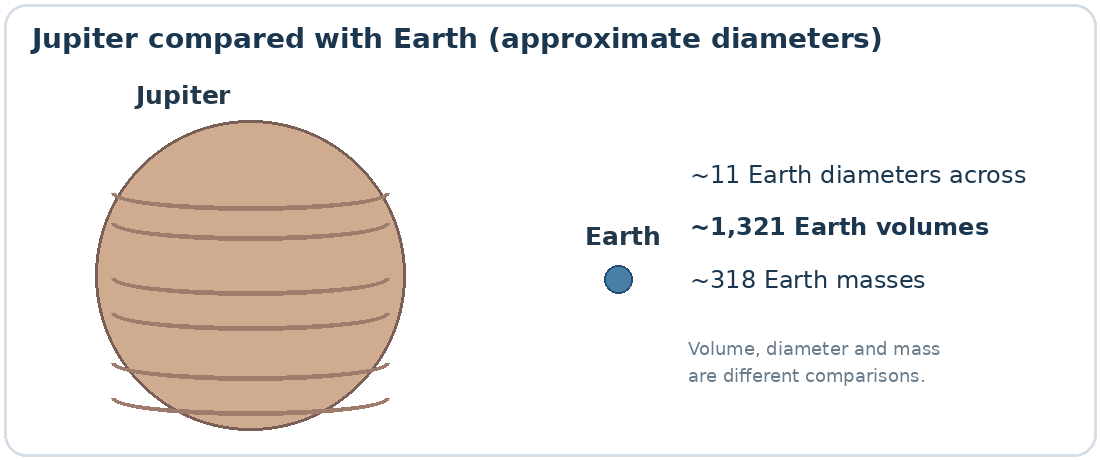
Original, simplified educational illustration; not to scale and not an observational photograph.
| Comparison | Approximate value |
| Diameter ratio | 11 Earth diameters |
| Volume ratio | 1,321 Earth volumes |
| Mass ratio | 318 Earth masses |
Diameter versus volume versus mass
About eleven Earth diameters would stretch across Jupiter's width. That is a linear measure, not the number of Earth-size volumes that fit inside. Volume grows with the cube of size, which is why an elevenfold diameter does not mean only eleven Earths by volume.
Jupiter is about 318 times Earth's mass, much less than its 1,321-to-one volume ratio. That mismatch reflects Jupiter's lower average density: it is composed primarily of hydrogen and helium rather than Earth's dense rock and metal.
Could you stack real Earths inside Jupiter?
Not in the literal way a cartoon suggests. Jupiter has no ordinary solid surface, its pressure and temperature change dramatically with depth, and a physical packing of spheres would leave empty spaces between them. The familiar figure compares abstract volumes while ignoring those complications.
It is nevertheless useful as a scale illustration. Comparing volume, mass, and diameter side by side makes clear why Jupiter is physically different from a supersized rocky Earth.
Jupiter versus the Sun
The Sun is vastly larger than Jupiter in both radius and volume and is a star capable of sustained hydrogen fusion. Jupiter remains a gas giant planet even though it dominates the solar system's planetary mass.
This scale comparison does not imply that Jupiter could ignite into a star by collecting a few Earths. Stellar fusion requires dramatically more mass and different interior conditions.
Frequently asked questions
How many Earths fit across Jupiter?
About eleven Earth diameters, depending on the diameter definition used.
Why is Jupiter not 1,321 times more massive than Earth?
It has much lower average density, so its volume ratio greatly exceeds its mass ratio.
Is Jupiter solid?
It is a gas giant without an Earth-like solid surface.