Star vs. Planet: Five Differences That Matter
Stars produce energy through nuclear fusion; planets orbit stars or travel independently. Compare light, size, temperature, and formation.
Star vs. Planet: Five Differences That Matter
A star is a self-gravitating astronomical body that can sustain nuclear fusion in its interior during part of its life. A planet is a different kind of body: it orbits a star or stellar remnant, has enough mass to become approximately round, and is not massive enough for sustained hydrogen fusion. The Sun is a star; Earth and Jupiter are planets.
1. Stars generate energy through fusion
In ordinary main-sequence stars, tremendous central pressures and temperatures enable hydrogen fusion into helium. The released energy eventually escapes as light and heat. Planets may retain internal heat or reflect starlight, but they do not run sustained hydrogen fusion like a star.
This is why Venus can appear dazzling in the evening sky without being a star. Its visibility comes from sunlight reflected by its thick clouds, not from a star-like nuclear furnace.
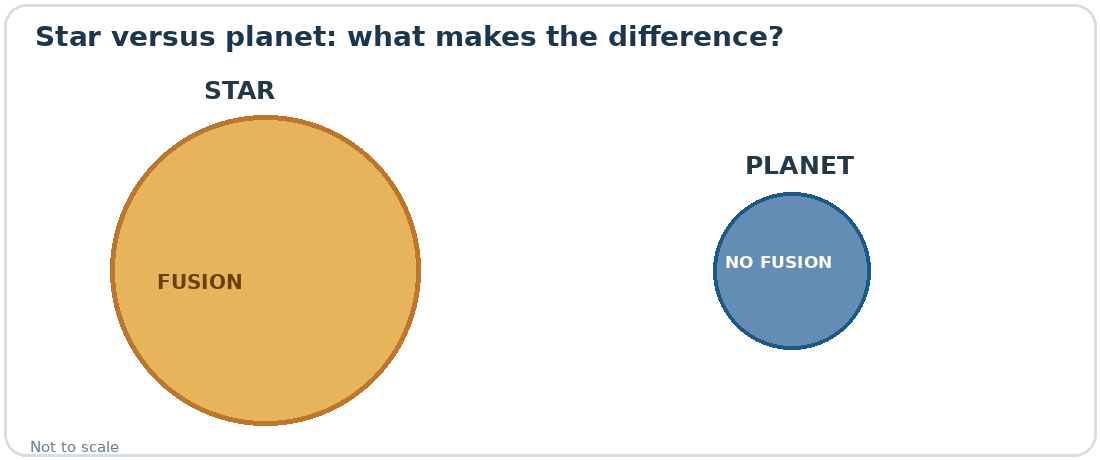
Original, simplified educational illustration; not to scale and not an observational photograph.
| Property | Star | Planet |
| Energy source | Nuclear fusion | Stored heat, reflected starlight |
| Examples | Sun, Proxima Centauri | Earth, Jupiter |
| Typical mass | Much higher | Lower than stars |
| Main observations | Starlight, spectra | Orbits, reflected/emitted light |
2. Stars and planets occupy different mass ranges
Stars are generally much more massive than planets, although the precise boundary with brown dwarfs depends on the physical definition used. A brown dwarf can fuse deuterium under some conditions but does not maintain ordinary hydrogen fusion like a main-sequence star.
Jupiter is giant compared with Earth yet far too low in mass to become a normal hydrogen-burning star. Popular claims that Jupiter is a 'failed star' oversimplify these physical thresholds.
3. Their appearance and atmospheres differ
Stars are hot plasma objects with photospheres, whereas terrestrial planets can have rocky surfaces and giant planets have deep gaseous envelopes. Solar flares, sunspots, and stellar winds are not the same as planetary cloud systems or storms.
Photographs from far away can be misleading: a bright star and a sunlit planet might both appear as unresolved points, so scientists use spectra, brightness variations, and motion to classify them.
4. Stars usually anchor planetary orbits
Gravity draws planets into bound orbits around their host stars, although planets can also be ejected and travel freely. Stars themselves orbit other stars in binaries and travel around galaxies. The distinction concerns the object's physics, not simply whether it moves.
Earth's daily and yearly motions also differ: rotating on its axis is not the same as making one revolution around the Sun.
5. Planet detection is different from star detection
Astronomers can observe stellar light directly across vast distances. Small planets are more difficult because they are faint next to their host stars. Transit dimming and radial-velocity shifts have therefore been especially important in finding exoplanets.
Classification works best with several observations, not an object's name alone. Pluto, for example, is a dwarf planet by the modern solar-system classification, while the Sun is indisputably a star.
Frequently asked questions
Is Jupiter a star?
No. It is a gas giant planet and cannot sustain hydrogen fusion.
Do planets make their own light?
They can emit thermal radiation, especially in infrared, but their familiar visible brightness is usually reflected starlight.
Is the Sun a planet?
No. The Sun is the star at the center of our solar system.
Related reading
What Is the Nearest Star to Earth? Sun and Proxima Centauri