How Many Stars Are in the Milky Way Galaxy?
The Milky Way holds roughly 100 billion or more stars, but no perfect census exists. Learn how astronomers estimate that total.
How Many Stars Are in the Milky Way Galaxy?
The Milky Way probably contains hundreds of billions of stars. Common published estimates range from about 100 billion to several hundred billion, with exact limits depending on the method and how faint, low-mass stars are modeled. No observatory has counted each star individually.
Why there is no complete star-by-star census
Dust blocks visible light through much of the galactic disk. Some of the most common stars are very faint red dwarfs, while objects on the far side of the galaxy are difficult to separate. Astronomers therefore combine direct counts, infrared observations, and models of stellar populations to infer the total.
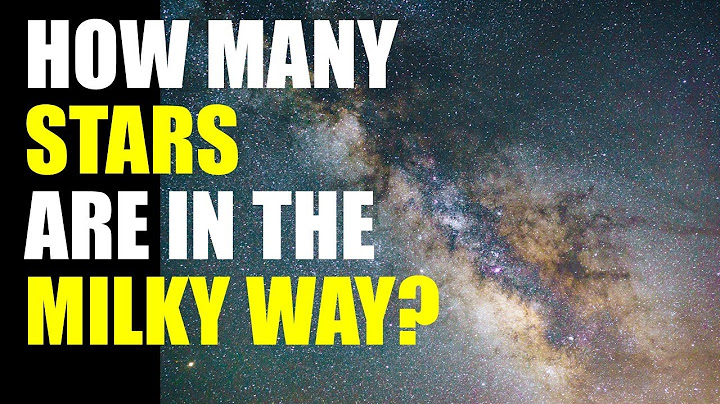
A count from one telescope catalog is not the galaxy's true total. The instrument's sensitivity, observing region, and the types of stars included affect how many objects can appear in the dataset.
How astronomers scale up observations
One approach estimates the galaxy's total stellar mass and uses a model of the distribution of stellar masses to infer a number of stars. Another maps representative areas of the disk and bulge, then corrects for obscured and faint regions. Both approaches must account for multiple-star systems and differences between young and old stellar populations.
Because a massive bright star contributes much more light than a small red dwarf, a total inferred from brightness is not equal to a direct number of stars without further assumptions.
What kinds of stars dominate by number
Low-mass red dwarfs are among the most numerous stars in the Milky Way. The Sun is an ordinary main-sequence star by astronomical standards, not a representative of every stellar mass. Giant stars may dominate the appearance of some photographs despite being far less common than dim dwarfs.
Star formation and stellar death change the population over time. The Milky Way has existed for billions of years, so we observe a mixture of new stars, ancient survivors, and stellar remnants.
Stars are not the same as planetary systems
A single star can host several planets, some stars are members of binaries, and some stellar populations have planets that remain undetected. Counting 'stars' does not answer how many planetary systems are in the galaxy.
It also does not answer how many stars exist in the observable universe. The Milky Way is one galaxy, and its inferred star count cannot be multiplied by one universal galaxy number without allowing for enormous differences among galaxies.
Frequently asked questions
Does the Milky Way have exactly 100 billion stars?
No. That figure is a useful lower-end approximation in many educational sources, not an exact total.
Are all those stars visible from Earth?
No. Dust, distance, faintness, and observing limits hide many of them.
Is the Sun counted?
Yes. The Sun is one of the Milky Way’s stars.
Related reading
What Galaxy Do We Live In? Earth in the Milky Way