Native American Tribes in Montana: Nations and History
Learn about Native nations in Montana, current tribal communities, reservation geography and key historical context.
Native American Tribes in Montana: Nations and History
Montana has eight federally recognized tribal nations representing multiple distinct peoples, according to Montana's Indian Education for All resources. The state also has seven major reservations commonly shown on statewide maps. Those two numbers are not contradictory: one counts sovereign governments, while the other refers to a set of reservation land areas. A reliable guide names the nations and explains how communities and geography fit together.
The eight federally recognized tribal nations
Montana's official educational materials identify the Blackfeet Tribe, Chippewa Cree Tribes, Confederated Salish and Kootenai Tribes, Crow Tribe, Fort Belknap Indian Community, Fort Peck Assiniboine and Sioux Tribes, Little Shell Tribe of Chippewa Indians, and Northern Cheyenne Tribe. Within these governments are distinct peoples and histories, including Salish, Pend d'Oreille, Kootenai, Assiniboine, Aaniiih, and others.
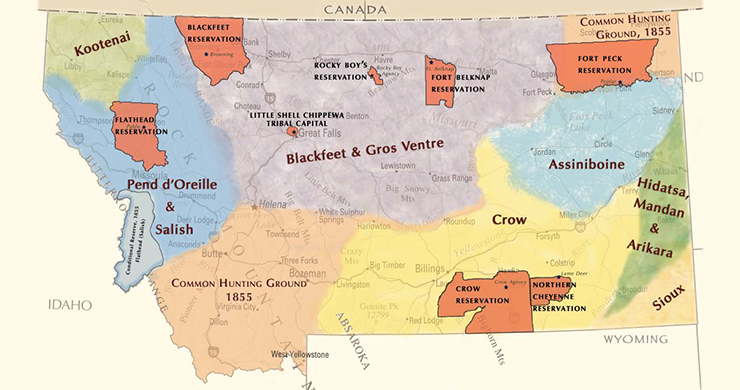
Because names, spellings, and governmental descriptions matter, use official tribal websites and the Montana Office of Indian Affairs for current self-identification and contact details.
Reservations and geographic orientation
Montana state and federal sources describe seven well-known reservations: Blackfeet, Rocky Boy's, Flathead, Crow, Fort Belknap, Fort Peck, and Northern Cheyenne. The Little Shell Tribe's land and governmental history are different, so simply placing an eighth reservation polygon next to the others would misstate the standard overview.
Reservation geography should not be confused with entire ancestral territories. Many cultural and historical relationships extend beyond the current reservation lines and across state boundaries.
History, governance, and treaties
The nations located in present-day Montana have distinct languages, alliances, treaties, experiences of colonization, and relationships to the Plains, mountains, and rivers. Federal policies altered landholding and mobility, but tribal governments and cultures continued. The legal status of particular areas depends on specific treaties and subsequent law, not a generalized claim that all Montana tribal lands share the same rules.
Tribal governments work with state and federal agencies while exercising their own authority under their applicable legal frameworks.
Cultural and community life now
Montana tribal nations support education, language learning, community celebrations, public health, local economies, natural-resource stewardship, and youth activities. Each has its own cultural practices and priorities. Public powwows and cultural centers may offer ways for visitors to learn, but participation rules and events vary and should be verified with the host.
The presence of many well-known historical narratives about the Plains should not eclipse contemporary writers, teachers, business owners, leaders, and families.
Maps and how to check them
The Montana Office of Indian Affairs and the state's Indian Education for All program provide useful regional orientation and official learning materials. For a legal land question, find the relevant tribal and government mapping authority and note the source year. Ancestral territory maps and current reservation maps answer different questions and should never be used interchangeably.
Readers seeking the national context can use the separate United States reservation-map guide rather than merging all state lists into one article.
Frequently asked questions
How many federally recognized tribal nations are in Montana?
Montana Indian Education for All resources identify eight federally recognized tribal nations.
How many major reservations are usually listed in Montana?
Seven major reservations are commonly listed in state and federal overviews.
Why are eight tribal nations and seven reservations both correct?
The numbers count different things: recognized tribal governments and a set of major reservation areas.
Where can I verify a Montana tribe’s official name?
Use the tribal government’s own website and Montana’s Office of Indian Affairs or Indian Education for All resources.
Related reading
Explore these focused guides for the next step in your research: