Understanding Physics: Energy, Motion, Forces, Measurements and Laws
Explore physics and energy with carefully defined concepts, evidence-led examples and focused guides to individual questions.
Understanding Physics: Energy, Motion, Forces, Measurements and Laws
Physics describes the relationships among motion, forces, energy, fields, and measurable properties of matter. Many laws use mathematical models that work under defined assumptions; the challenge is recognizing when the assumptions hold.
How the field is organized
The distinction between a quantity and its direction matters: speed is not velocity, and a force can cause rotation depending on its line of action. Energy also comes in different bookkeeping categories, yet total energy is conserved in an isolated system.
Core ideas and how to read them
Equations are not just formulas to memorize. Each variable corresponds to a measured quantity, and the units provide a quick test of whether a calculation is physically meaningful. Classical mechanics works well for ordinary objects, but atomic and relativistic problems require other descriptions.
A useful physics model declares what is being measured, what is held constant, and which forces or transfers are included. Without those details, even a correct equation can be used incorrectly.
Explore the topic library
Kinetic Energy — Kinetic energy is energy associated with motion.
Law of Conservation of Energy — The law of conservation of energy states that the total energy of an isolated system remains constant, even as energy changes form or moves between parts.
Torque — Torque describes the turning effect of a force about an axis or pivot.
Rotational Inertia — Rotational inertia, or moment of inertia, measures an object's resistance to changes in rotational motion around a chosen axis.
Mechanical Energy — Mechanical energy is the sum of kinetic and potential energy used to describe a system's motion and configuration.
Speed vs. Velocity — Speed measures how fast something moves, while velocity includes both speed and direction.
Magnetic Fields — A magnetic field describes the influence associated with magnets, electrical currents, and changing electric fields.
Specific Gravity — Specific gravity is the ratio of a material's density to the density of a reference substance, commonly water for solids and liquids.
Pauli Exclusion Principle — The Pauli exclusion principle says that two identical fermions cannot occupy the same quantum state within a quantum system.
Gauss's Law — Gauss's law relates the net electric flux through a closed surface to the electric charge enclosed by that surface.
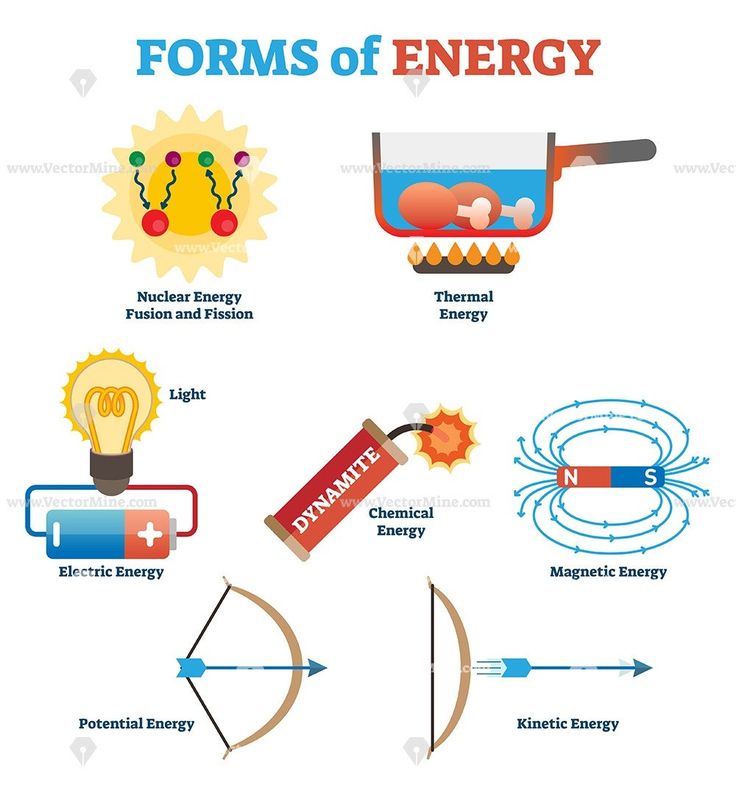
Types of Energy — Energy can be described in forms such as kinetic, potential, thermal, chemical, electrical, electromagnetic radiation, and nuclear energy.
How explanations are evaluated
Examples such as a moving bicycle, a turning door, and a compass help tie abstract principles to the world. They are starting models; air resistance, friction, geometry, and measurement uncertainty matter in real situations.
Measurements, repeated experiments, and the consistency of units help test a physical account. For complex systems, models may be refined to include friction, thermal effects, geometry, or quantum behavior.
Questions worth asking
What exactly is being defined? Which mechanisms have been established, and which statements describe simplified models? How does the evidence change when time, location, scale, or context changes?
Use the linked articles for the detailed definitions, examples, and limits. This page is a directory and overview rather than a replacement for the individual subject entries.
