Types of Stars: Color, Mass and Life Cycles
Types of Stars: Color, Mass and Life Cycles Explore evidence-based facts, context and common misconceptions.
Types of Stars: Color, Mass and Life Cycles
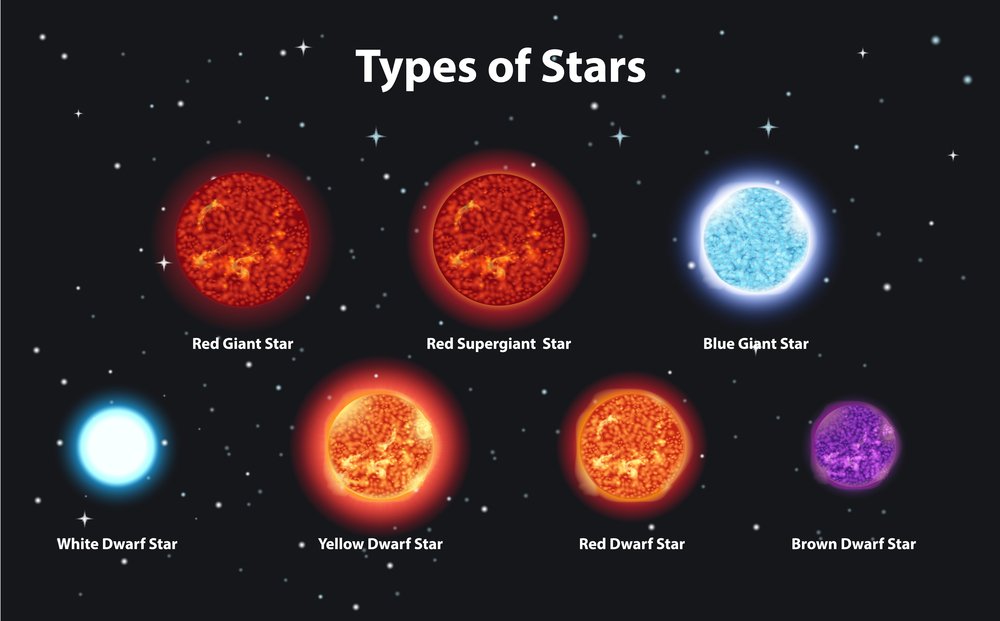
Astronomers classify stars by surface temperature, color, luminosity, and evolutionary stage. Hot blue stars and cooler red stars occupy different regions of the temperature scale, and a star’s mass strongly influences its lifetime.
The essentials
The main sequence includes stars steadily fusing hydrogen in their cores; other stages include giants, supergiants, and white dwarfs. A red giant is an evolutionary stage, not simply a main-sequence star with a red color.
What makes this subject distinctive
The Sun is a G-type main-sequence star. Massive stars generally use their nuclear fuel more quickly than low-mass stars, even though they begin with larger supplies of fuel.
Different dates, instruments, definitions, and model assumptions can produce different figures without one source necessarily being careless. For counts and distances, always check the stated unit and whether a number applies to a confirmed object, a sample estimate, or the entire observable universe.
Common misconceptions and limits
Popular lists sometimes mix categories based on temperature with stages such as neutron stars. A neutron star is a compact stellar remnant, so comparisons should identify which classification system is being used.
Astronomy depends on careful definitions. A count can be revised after new observations, while a distance may be an estimate derived from an accepted model. Always pair a time-sensitive number with a reporting date and distinguish confirmed observations from proposed candidates.
What astronomers can actually measure
Researchers combine telescopic observations, orbital dynamics, spectra, and physical models. Some quantities can be measured directly; others are inferred from incomplete samples. A scientific estimate is meaningful only when its uncertainty and observational limits are acknowledged.
Key points at a glance
Astronomers classify stars by surface temperature, color, luminosity, and evolutionary stage.
The main sequence includes stars steadily fusing hydrogen in their cores; other stages include giants, supergiants, and white dwarfs.
The Sun is a G-type main-sequence star.
Frequently asked questions
What does current evidence show?
Astronomers classify stars by surface temperature, color, luminosity, and evolutionary stage.
Why can observations or estimates change?
The main sequence includes stars steadily fusing hydrogen in their cores; other stages include giants, supergiants, and white dwarfs.
What is the main source of uncertainty?
Popular lists sometimes mix categories based on temperature with stages such as neutron stars.
Explore related guides
Astronomy for Curious Readers: Stars, Galaxies, Planetary Moons and the Solar System
