Earth’s Diameter: Equatorial and Polar Measurements
Earth’s Diameter: Equatorial and Polar Measurements Explore evidence-based facts, context and common misconceptions.
Earth’s Diameter: Equatorial and Polar Measurements
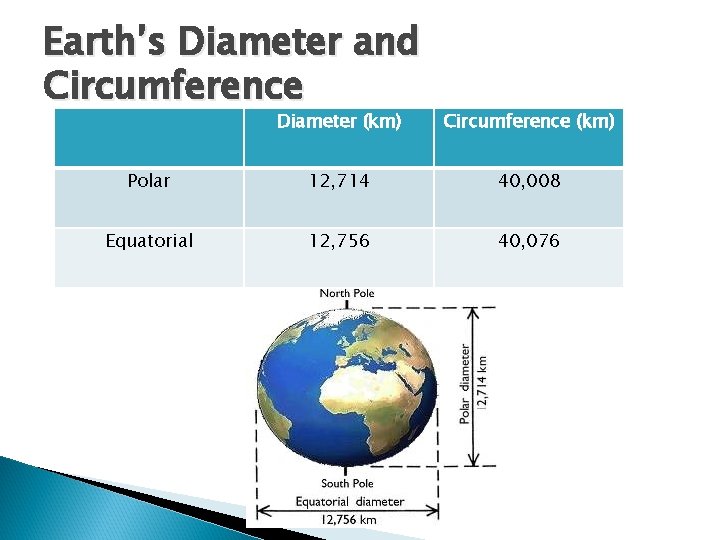
Earth is not a perfect sphere. Its equatorial diameter is about 12,756 kilometers, while the pole-to-pole diameter is about 12,714 kilometers. The difference results mainly from rotation, which makes Earth bulge slightly around its equator.
The essentials
Scientists describe the planet using reference ellipsoids and geodetic models rather than assuming a perfectly round ball. A diameter passes through the center; a circumference measures the distance around the surface.
What makes this subject distinctive
Different textbooks may quote around 12,742 kilometers as an average diameter. That figure does not contradict the equatorial and polar values; it summarizes a slightly flattened planet.
Different dates, instruments, definitions, and model assumptions can produce different figures without one source necessarily being careless. For counts and distances, always check the stated unit and whether a number applies to a confirmed object, a sample estimate, or the entire observable universe.
Common misconceptions and limits
Precision depends on the model used, altitude reference, and measurement goal. For everyday comparisons, rounded figures are more meaningful than digits that imply unwarranted accuracy.
Astronomy depends on careful definitions. A count can be revised after new observations, while a distance may be an estimate derived from an accepted model. Always pair a time-sensitive number with a reporting date and distinguish confirmed observations from proposed candidates.
Reading a space headline carefully
A dramatic number is rarely the whole story. Ask what was counted, which region was observed, what remains invisible, and whether the finding supersedes an earlier measurement. This prevents a precise-looking answer from obscuring genuine scientific uncertainty.
Key points at a glance
Earth is not a perfect sphere.
Scientists describe the planet using reference ellipsoids and geodetic models rather than assuming a perfectly round ball.
Different textbooks may quote around 12,742 kilometers as an average diameter.
Frequently asked questions
What does current evidence show?
Earth is not a perfect sphere.
Why can observations or estimates change?
Scientists describe the planet using reference ellipsoids and geodetic models rather than assuming a perfectly round ball.
What is the main source of uncertainty?
Precision depends on the model used, altitude reference, and measurement goal.
Explore related guides
Astronomy for Curious Readers: Stars, Galaxies, Planetary Moons and the Solar System
