Commensalism Examples: Real Animal and Plant Relationships
Specific cases, how benefit/neutrality is tested, and disputed examples.
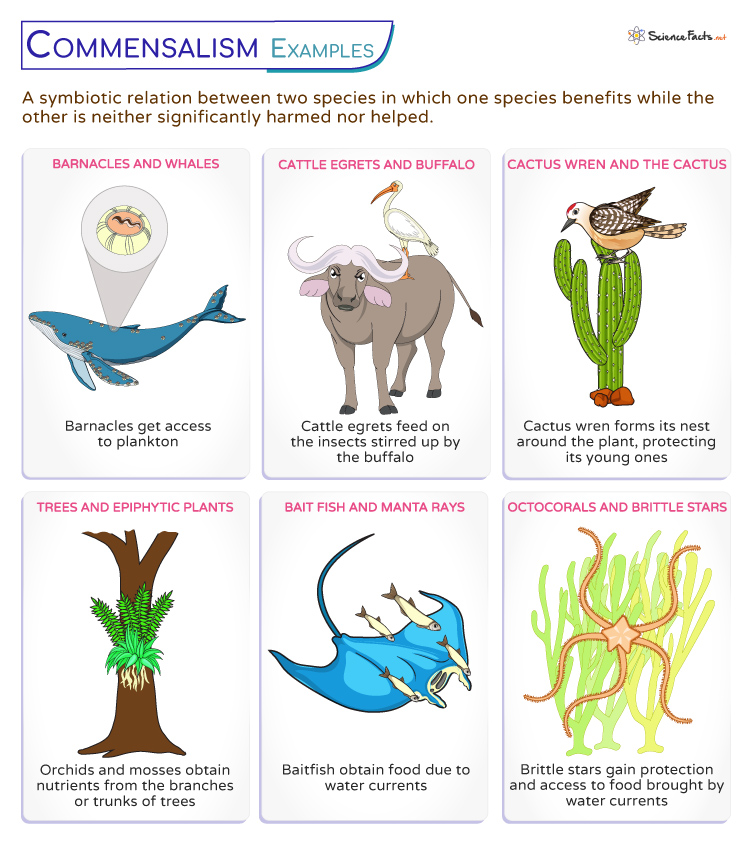
Commensalism Examples: Real Animal and Plant Relationships
Commensalism occurs when one species benefits and the other experiences no demonstrated significant benefit or harm. The key is a precise definition supported by examples that do not confuse related concepts.
Meaning and key distinctions
Definitions matter because everyday terms can cover different scientific mechanisms. Start with what is being classified, then ask what evidence would make one interpretation preferable to another.
Where the concept applies
Examples often discussed include barnacles attached to large marine animals and certain epiphytes growing on tree branches. The examples still need ecological context.
Ecological processes can look different when researchers change the geographic or time scale being studied.
How it works in an ecosystem
A hitchhiker may gain transportation or access to food, while its host appears little affected. Measuring 'no effect' is harder than it first sounds.
Real ecosystems are networks with feedback loops. Changes in one part can alter several others.
Examples and changing conditions
If the attached organism adds drag, increases injury or changes feeding, the relationship may not remain truly commensal. Conditions matter.
Mechanisms need to be distinguished from outcomes. Similar-looking outcomes can arise for different reasons.
Common misconceptions
A useful explanation distinguishes direct observation from interpretation. For classroom answers, clearly state the definitions being used rather than treating ambiguous classifications as universal truths.
The apparent neutrality of a barnacle riding a whale or an epiphyte using a tree branch needs testing. If a measurable cost to the host appears, the classification may require revision.
How to use the term accurately
A clear definition is the first step; a good example then shows where the boundary of that definition lies. Scientific terms are useful only when assumptions are stated and examples match those assumptions.
When checking an example, name the organisms and conditions involved rather than relying only on a textbook diagram.
Quick takeaways
Examples often discussed include barnacles attached to large marine animals and certain epiphytes growing on tree branches.
A hitchhiker may gain transportation or access to food, while its host appears little affected.
Do not automatically call cattle egrets on grazing mammals pure commensalism without discussing evidence and variation.
Frequently asked questions
What is an example of commensalism?
Commensalism occurs when one species benefits and the other experiences no demonstrated significant benefit or harm.
Where can the idea be applied?
Examples often discussed include barnacles attached to large marine animals and certain epiphytes growing on tree branches.
What is an important limitation?
Do not automatically call cattle egrets on grazing mammals pure commensalism without discussing evidence and variation.
