Native American Tribes in Virginia: History and Today
Learn about Native American tribes in Virginia, their histories, present-day communities and important differences in legal recognition.
Native American Tribes in Virginia: History and Today
Virginia is home to living Native American tribal nations whose histories extend long before English settlement at Jamestown. Federal and state recognition are different statuses, and a responsible guide names each category accurately. Federal agency resources identify seven federally recognized tribes in Virginia, alongside other state-recognized communities. Native Virginia is not just a subject from colonial history books.
Seven federally recognized Virginia tribes
Federal resources identify the Pamunkey Indian Tribe, Chickahominy Indian Tribe, Chickahominy Indian Tribe–Eastern Division, Monacan Indian Nation, Nansemond Indian Nation, Rappahannock Tribe, and Upper Mattaponi Indian Tribe as federally recognized. The Pamunkey received federal recognition in 2015; six others were federally recognized in 2018. Use each nation's official name when preparing a directory.
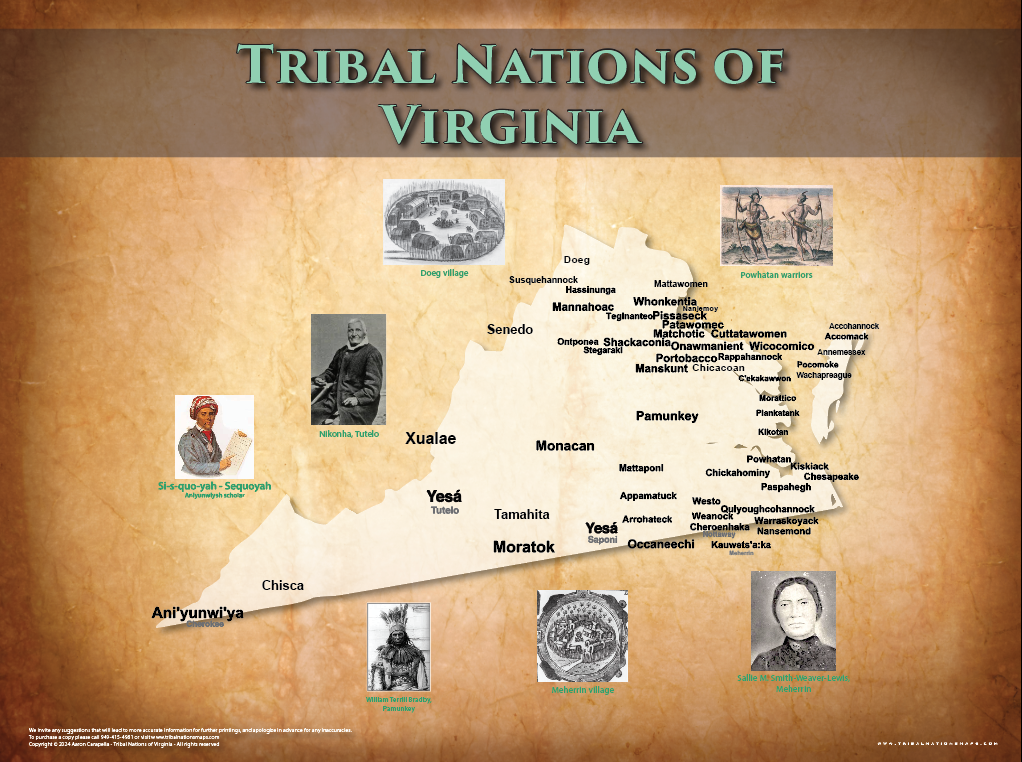
These governments are distinct. Recognition dates and legal status should be presented accurately rather than bundled into a single story about a generic 'Virginia tribe.'
State recognition is a separate category
Virginia also recognizes tribal communities through state-level processes. Being state-recognized is not the same thing as having the federal government-to-government status attached to federal recognition. State recognition can still be meaningful to a community's civic and cultural life, but it should not be portrayed as an identical legal status.
If preparing a list, label the source authority and year of update for each category. When the status of a specific community matters, consult its current materials and Virginia government sources.
History beyond the Jamestown story
Accounts of Native Virginia often begin with the Powhatan paramount chiefdom and the establishment of Jamestown, but that narrow frame leaves out many nations and thousands of years of history. Different communities had their own relationships with waterways, farms, trade networks, languages, and neighboring peoples. Colonial records also carry the perspectives and biases of the people who wrote them.
Historic place names and surviving documents can support learning, but Native communities' own historical and oral accounts deserve attention.
Communities and cultural life today
Virginia tribal governments and citizens work on education, government affairs, community gatherings, language and cultural projects, and environmental issues. The Pamunkey Indian Tribe, Monacan Indian Nation, and other nations maintain their own public institutional identities. It is inaccurate to imply that Virginia's Native peoples disappeared after the colonial period.
For public events or student visits, check tribal government calendars and respect visitor requirements rather than treating every community place as a historic display.
How to read a Virginia tribal map
A map showing a modern tribal community, a treaty-era territory, an archaeological site, and a legal reservation boundary may use very different data. Check title, year, author, and legal status before comparing shapes. Contemporary state lines and county names should not be assumed to define ancestral homelands.
This is a Virginia-specific overview; readers interested in Cherokee governments should use the separate Cherokee guide rather than suggesting all Southeastern nations have the same history.
Frequently asked questions
How many federally recognized tribes are in Virginia?
Federal government sources identify seven federally recognized tribal nations.
Is Pamunkey a federally recognized tribe?
Yes. The Pamunkey Indian Tribe received federal recognition in 2015.
Are state-recognized tribes federally recognized?
Not necessarily. The state and federal recognition processes are distinct.
Do Native American communities still live in Virginia?
Yes. Tribal governments and communities continue cultural, civic, and educational work today.
Related reading
Explore these focused guides for the next step in your research: