Native American Tribes in Washington State: Overview
Learn about Native nations in Washington State, tribal sovereignty, geographic regions and reliable resources for further reading.
Native American Tribes in Washington State: Overview
Washington state has 29 federally recognized tribes, according to the Washington Governor's Office of Indian Affairs. They are sovereign governments with distinct histories, cultures, territories, and contemporary programs. Many have treaty relationships that affect fishing, wildlife, and stewardship issues. A statewide overview helps readers find authoritative information without treating the 29 nations as culturally identical.
Who are the tribal nations of Washington?
Washington's recognized tribal governments include the Lummi Nation, Makah Tribe, Quinault Indian Nation, Puyallup Tribe, Yakama Nation, Tulalip Tribes, Spokane Tribe, and many others. The Washington Governor's Office of Indian Affairs provides an official directory of the 29 recognized nations, which should be checked for names and current contact details.
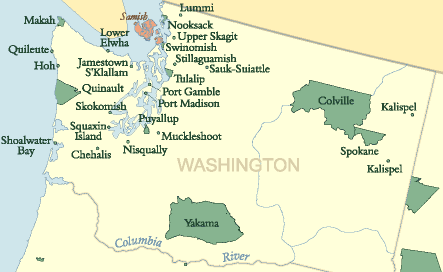
A short article cannot represent every community with equal depth. A reliable approach introduces several regions and gives readers a path to each nation's public materials rather than inventing one statewide origin story.
Coast, Puget Sound, plateau, and inland regions
Washington's geography shapes different histories of fishing, travel, trade, agriculture, and settlement. Coastal and Puget Sound communities have deep connections to marine and river environments; inland and plateau nations have their own languages, homelands, and food systems. Regional terms are useful orientation tools but do not replace a nation's name or account of its history.
Some tribal histories extend across what are now state or international boundaries. A modern Washington map does not define all longstanding cultural territory.
Sovereignty, treaties, and natural resources
Washington has significant treaty histories and contemporary government-to-government relationships. Treaty-protected fishing rights and co-management responsibilities are major subjects in discussions of salmon and environmental stewardship. The details vary by nation and legal history; not every tribe has the same treaty or governing arrangement.
State agencies work with tribal governments on wildlife, habitat, public safety, and other matters. For legal specifics, consult the relevant nation and the applicable law rather than drawing conclusions from a generalized state guide.
Tribal governments and life today
Tribes operate governments, courts, schools, cultural departments, businesses, and community services in different configurations. Many support language revitalization, fisheries work, youth programs, and museums. Native people also live in Washington's cities and towns outside tribal land areas.
A visitor should look for public programs offered or endorsed by each nation and respect areas and occasions not open to outsiders.
Finding reliable Washington tribal maps
Use the Governor's Office of Indian Affairs for a statewide government directory and tribal government mapping sources for local details. US Census products may be helpful for statistical areas, while official land records are needed for legal boundaries. If a map uses ancestral-territory outlines, label it as educational, not a reservation atlas.
Avoid applying a California or Montana tribal count to Washington; these state-specific numbers answer different questions.
Frequently asked questions
How many federally recognized tribes are in Washington state?
The Washington Governor’s Office of Indian Affairs lists 29.
Are all Washington tribes from one cultural region?
No. The state spans coastal, inland, plateau, and other regions with distinct histories and communities.
Why are treaty rights often discussed in Washington?
Treaties and later legal decisions affect matters including fishing, resource stewardship, and government-to-government relations.
Where can I find official tribal websites?
Start with the Washington Governor’s Office of Indian Affairs directory and follow each nation’s own public website.
Related reading
Explore these focused guides for the next step in your research:
Native Peoples Today: Nations, Communities and Sovereignty
Native American Tribes in California: Nations and Communities