What Are Electromagnetic Waves?
Learn how electromagnetic waves carry energy, how frequency and wavelength relate, and where radio waves and gamma rays fit.
What Are Electromagnetic Waves?
SCIENCE EXPLAINED • US ENGLISH • EDITORIAL SNAPSHOT: NOVEMBER 1, 2026
Electromagnetic waves are traveling disturbances in electric and magnetic fields that carry energy through space. They include radio waves, microwaves, infrared radiation, visible light, ultraviolet light, X-rays, and gamma rays. The same underlying physics connects a radio broadcast to sunlight; the major differences are wavelength, frequency, photon energy, and how matter interacts with each band.
Electric and magnetic fields in a traveling wave
An electric field acts on electric charges, while a magnetic field acts on moving charges and magnetic moments. In a propagating electromagnetic wave, changing electric and magnetic fields sustain one another. In a simple plane wave moving through a vacuum, the fields oscillate at right angles to each other and to the direction of travel.
That description is a useful idealization, not a claim that every real beam looks like two neat sine curves. Antennas, lenses, surfaces, and nearby matter can produce more complex field patterns. Also, a static magnetic field is not itself an electromagnetic wave. Time variation and propagation are the key ideas.
Wavelength, frequency, and speed
Frequency counts oscillations per second and is measured in hertz (Hz). Wavelength is the distance between equivalent points on successive wave cycles and is measured in meters. In vacuum they satisfy c = fλ, where c is approximately 299,792,458 meters per second. If frequency rises, wavelength must decrease for waves traveling at this same vacuum speed.
Within a material, the propagation speed and wavelength may change because the material responds to the fields; frequency is generally set by the source. This matters when comparing radio propagation through air with light moving through glass or water. High-frequency radiation is not intrinsically faster than low-frequency radiation in vacuum.
Reading the electromagnetic spectrum
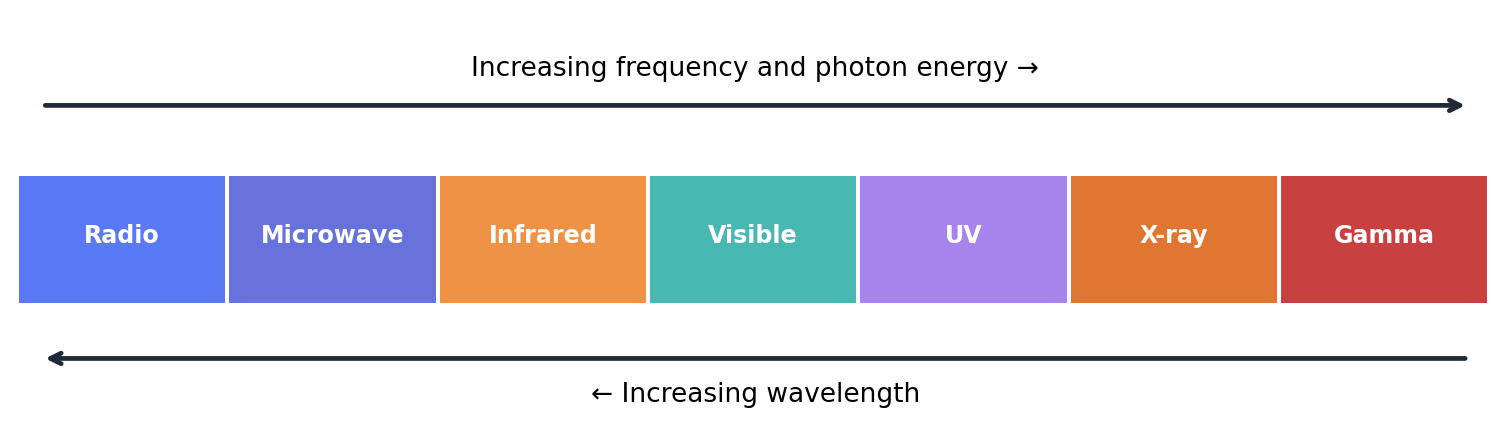
Original educational illustration (schematic; not to scale).
At one end are long-wavelength radio signals. Moving toward shorter wavelengths, the sequence passes through microwaves, infrared, visible light, ultraviolet, X-rays, and gamma rays. The dividing lines are conventional and some ranges overlap. Visible light occupies only a narrow band of a vastly larger spectrum.
Higher frequency means greater energy per photon, E = hf. This helps explain why some high-frequency bands can ionize atoms while ordinary radio signals usually cannot. It does not mean every bright radio transmitter is harmless in every context: intensity, exposure, and frequency all matter.
Everyday examples
A Wi-Fi router communicates using radio-frequency electromagnetic waves. Infrared sensors detect thermal emission. The Sun provides visible light and ultraviolet radiation. Medical imaging can use X-rays, and researchers measure gamma-ray photons from energetic cosmic processes. All are electromagnetic, but each technology needs a detector suited to its portion of the spectrum.
A common misconception is that sound waves belong on the same spectrum. Sound is a mechanical wave that needs a material medium; electromagnetic waves can propagate across vacuum. Another misconception is that radio signals are not 'light.' In physics, light can mean electromagnetic radiation broadly, although ordinary speech reserves the word for visible wavelengths.
A small calculation to connect the ideas
Consider a signal with a frequency of 100 million cycles per second (100 MHz). Using the vacuum relation λ = c/f gives a wavelength of about 3 meters. A visible-light wave has a far shorter wavelength because its frequency is much higher. Both examples obey the same underlying speed relationship. Calculations like these are helpful for learning the spectrum, but practical antenna systems involve many additional factors.
Frequently asked questions
Do electromagnetic waves need air? No. They travel through vacuum, including between the Sun and Earth.
Are radio waves and gamma rays the same speed? In vacuum, yes; their wavelengths, frequencies, and photon energies differ.
Is a steady magnetic field a wave? Not by itself. A wave involves changing fields that propagate.
Explore related science topics
For a closer look at connected concepts, read electric and magnetic fields; gamma-ray fundamentals, and radio-wave speed and production.