What Is the Nearest Star to Earth? Sun and Proxima Centauri
The Sun is Earth’s closest star; Proxima Centauri is the nearest star beyond the Sun. Learn both answers, their distances, and the Alpha Centauri system.
What Is the Nearest Star to Earth? Sun and Proxima Centauri
The nearest star to Earth is the Sun, about 93 million miles (150 million kilometers) away on average. If the question excludes our own star, the nearest known star is Proxima Centauri, a small red dwarf about 4.24 light-years away in the Alpha Centauri system.
Why the Sun is the correct first answer
A star is an enormous luminous sphere of hot plasma powered primarily by nuclear fusion. The Sun meets that definition; it simply looks larger and brighter than the other stars because Earth orbits it. The average Sun–Earth separation is one astronomical unit, the distance scale often used within the solar system.
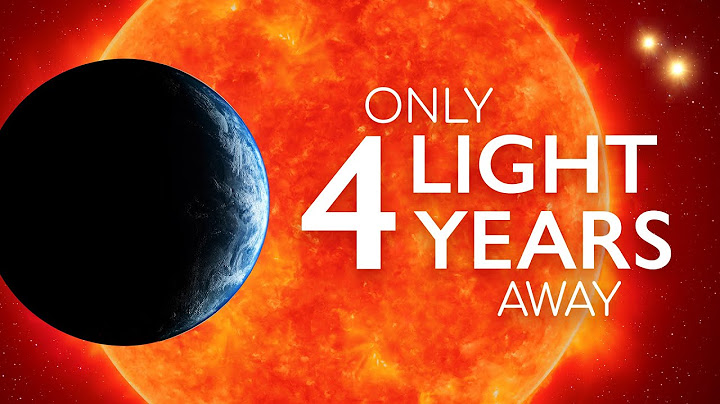
People sometimes ask for the closest 'other' star without saying so. A good comparison states both answers, rather than incorrectly claiming that the nearest star is always Proxima Centauri.
Proxima Centauri and its stellar neighbors
Proxima is a cool, faint red dwarf with a gravitational association to the Alpha Centauri system. Alpha Centauri A and B are a brighter pair visible in southern skies and slightly farther from Earth. Their combined system lies roughly 4.3 to 4.4 light-years away.
A light-year measures distance, not time: it is how far light travels in one year through a vacuum. Even traveling at light speed would take more than four years to cross the distance to Proxima, and present spacecraft operate far below that speed.
How astronomers measure stellar distance
For nearby stars, parallax is especially powerful. Observers measure the apparent shift of a star relative to much more distant background objects as Earth changes position in its orbit. Smaller shifts usually imply greater distance.
Space astrometry missions such as ESA's Gaia have made precise positions and motions available for huge numbers of stars. This allows more reliable mapping of our stellar neighborhood, including stars that are not especially bright in the sky.
What about planets around Proxima?
Astronomers have reported planets associated with Proxima Centauri, including Proxima b. Their existence makes the system interesting for research into nearby exoplanets, but being near in galactic terms does not make them habitable or reachable with current technology.
Proxima is an active red dwarf capable of energetic flares, which may affect planets' atmospheres. Distances, stellar activity, and orbital conditions need to be assessed separately from headlines about a 'second Earth.'
Frequently asked questions
Is the North Star the closest star?
No. Polaris is far more distant than the Sun and Proxima Centauri.
How far away is Proxima Centauri?
About 4.24 light-years from Earth.
Is a light-year a period of time?
No. It is a unit of distance.
Related reading
What Galaxy Do We Live In? Earth in the Milky Way
Star vs. Planet: Five Differences That Matter
How Fast Does Earth Move Through Space? The Frames of Reference