Halloween Movies in Order: Michael Myers Timelines Explained
Watch the Halloween movies in order with a clear guide to release dates and the different Michael Myers timelines.
Halloween Movies in Order: Michael Myers Timelines Explained
The Halloween movie series contains several competing continuities, so “in order” can mean release order or story order. Start with a clear distinction: not every sequel follows the same events, and Halloween III: Season of the Witch is a standalone entry. This guide concerns the horror franchise, not the October 31 holiday.
Halloween Films in Release Order
The 13 theatrical films through 2022 in release order are: Halloween (1978); Halloween II (1981); Halloween III: Season of the Witch (1982); Halloween 4: The Return of Michael Myers (1988); Halloween 5: The Revenge of Michael Myers (1989); Halloween: The Curse of Michael Myers (1995); Halloween H20: 20 Years Later (1998); Halloween: Resurrection (2002); Halloween (2007); Halloween II (2009); Halloween (2018); Halloween Kills (2021); and Halloween Ends (2022). The 2007 and 2009 movies are Rob Zombie’s remakes, not direct continuations of the original storyline.
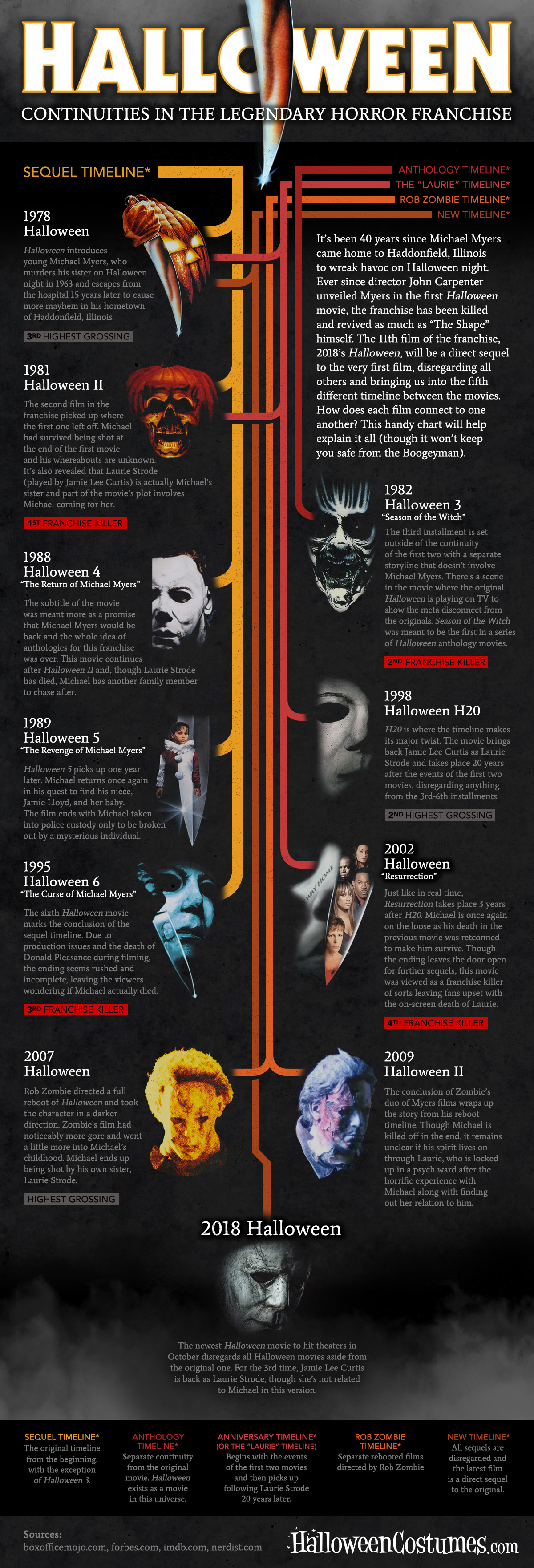
One source of confusion is the repeated title Halloween. There is the John Carpenter original from 1978, Rob Zombie’s 2007 remake and the 2018 sequel named Halloween. They are not interchangeable films. A list that prints only the title and leaves off the year can make a watch order misleading. The same applies to Halloween II, which exists in different continuities. On a website, make the release year visible every time and avoid merging rating, cast or streaming metadata from different entries. A clear timeline chart can help, but the prose should also explain where branches split so readers are not forced to decode a complicated diagram.
Main Michael Myers Continuities
The original continuity begins with Halloween (1978), followed by Halloween II (1981), Halloween 4 (1988), Halloween 5 (1989) and Halloween: The Curse of Michael Myers (1995). The H20 branch instead follows Halloween (1978), Halloween II (1981), Halloween H20 (1998) and Halloween: Resurrection (2002). These branches contradict one another in important ways, so do not blend them into one chronology.
The main continuity question is why Laurie Strode’s story changes between branches. In the original 1978-to-1995 run, the sequels build a longer series of Myers encounters. H20 follows the first two films but not the intervening sequels. The 2018 trilogy instead treats the 1978 film as its sole prior story. New viewers who combine dialogue from different branches may think they have found a plot contradiction when they are actually crossing separate timelines.
Where Alternate Timelines Split
A separate continuity begins with the 1978 original and jumps to Halloween (2018), Halloween Kills (2021) and Halloween Ends (2022), ignoring earlier sequels for that particular story. Rob Zombie’s Halloween (2007) and Halloween II (2009) tell an independent remake story. Halloween III: Season of the Witch (1982) is unrelated to Michael Myers, making it a stand-alone seasonal horror film.
First Film and Trilogy Questions
If you are new to the franchise, start with Halloween (1978), then decide which sequel branch interests you. The 2018 trilogy is a compact modern follow-up to the original. If you want to study how the franchise evolved, watch the films by theatrical release rather than forcing contradictory timelines together. These groupings clarify the stories without making claims about current streaming availability.
A practical beginner plan is to watch Halloween (1978) and Halloween (2018), then Halloween Kills (2021) and Halloween Ends (2022). If you prefer the late-1990s branch, follow the original with Halloween II (1981) and Halloween H20 (1998). To see how filmmaking styles change, use full release order. These are alternative routes, not a universal ranking of which entries are best.
A useful way to apply these ideas
Make one small version first, then adjust it for your audience, space and resources. The following checks are specific to this topic; use them as a short planning pass instead of assuming every example fits every situation.
Practical takeaways
Use release order for a full franchise marathon.
Choose one continuity before following a plot sequence.
Remember that Halloween III is a standalone story.
Verify provider availability separately from story order.
Should I watch Halloween III before Halloween 4? In release order, yes; for a Michael Myers story sequence, Halloween III is optional because it is standalone.
Related Halloween guides