Hamster Cages With Tubes: What to Check
Understand modular hamster tube cages, ventilation and cleaning problems, and how to provide proper floor space and safe tunnels.
Hamster Cage With Tubes: What to Check First
A colorful hamster cage with tubes can look entertaining, but elaborate modular systems often prioritize human visibility over the hamster's needs. The biggest question is not how many plastic tunnels connect the modules; it is whether the animal has a safe, spacious primary enclosure with deep bedding, ventilation and easy access to essentials. Tube systems deserve close scrutiny before purchase or reuse.
A tube network does not add meaningful main floor space
Measure the primary base first. Blue Cross recommends a usable footprint of at least 100 × 50 cm, with room for deep burrowing bedding and a suitable wheel. Three tiny boxes linked by plastic tubes are not equivalent to one uninterrupted enclosure of that size. The same is true of tall towers that advertise multiple levels as if stacked platforms were new ground-level territory.
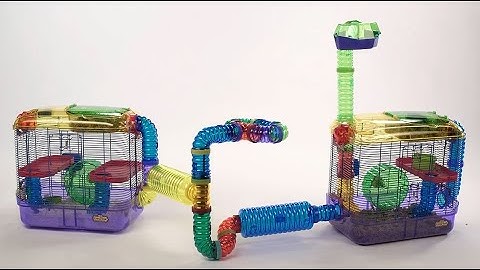
If the main compartment cannot hold a continuous deep-bedding area, treat the modular system as an inadequate permanent home, even if its product photos show a hamster moving through several tunnels. The priority is to upgrade the principal habitat.
Ventilation and moisture inside plastic tubes
Hard-plastic enclosed connectors can trap moisture and accumulate food, urine and condensation. Poor airflow makes cleaning difficult and may expose an animal to unpleasant damp conditions. Look for genuinely accessible sections that separate without sharp tools and can be washed, rinsed and completely dried before reassembly.
Clear plastic lets you see some debris but does not prove a tunnel is clean. Check hidden joints, elbow bends and caps, and examine the smell inside each section. A design that cannot be disassembled for routine inspection is a poor choice.
Diameter matters more for Syrians
Syrian hamsters are larger than many dwarf species, and their cheek pouches may be full when they move through a connection. A tube that looks wide enough around an empty hamster can be uncomfortably narrow during normal food transport. Tight curves, vertical climbs and stiff joints can cause bottlenecks or trapping.
Never push a hamster into a tube to test fit. Choose open, wide tunnels that the animal can enter and leave freely without scraping its sides. Watch for hesitation, backing out repeatedly or panicked attempts to turn around.
Climbing can create additional hazards
Tall vertical tube stacks introduce awkward climbing and possible falls at open junctions. Dwarf hamsters can have particular difficulty with steep climbs, as Blue Cross notes. Long ladders and platforms do not compensate for a secure level floor. Accessible ramps with gentle slopes may be easier, but they still must not force the animal to climb simply to reach food or water.
Check every opening for escape risk, including connectors that can loosen as plastic ages. A hamster may exploit a gap that looks too small or chew a damaged edge. Routine inspection matters as much as the original assembly.
Enrichment tunnels are different
Wide cardboard tubes, cork tunnels and appropriately sized hide entrances placed *within* a large primary enclosure can provide shelter and opportunities to explore. These are not the same as a network of small, sealed living modules. The important distinction is whether a tunnel is optional enrichment or a compulsory narrow passage between essential resources.
Keep a safe route to water, wheel and hides without relying on the tunnel. Replace cardboard once it becomes wet or sharp and avoid adhesives, coatings or staples that can be chewed off.
What to do if you already own a tube cage
Start by measuring the main base and evaluating bedding capacity, wheel clearance and ventilation. If it is too small, plan an upgrade to a spacious enclosure. Reuse a clean wide tube only if it is appropriate for the animal and can be accessed for inspection; otherwise set it aside rather than trying to justify keeping the small cage.
A supervised playpen can offer temporary extra exploration, but it is not a substitute for an adequate home cage. Avoid promotional claims that a larger number of modules automatically means a better habitat.
Frequently Asked Questions
Are all hamster tunnels unsafe? No. Wide, accessible enrichment tunnels can be useful within a properly sized enclosure.
Do tubes count toward cage floor space? No. Connected small modules do not replace the continuous main floor footprint.
Can a Syrian hamster get stuck? Yes, especially in narrow bends or tubes that fail to accommodate full cheek pouches.
What is wrong with vertical tube towers? They can be hard to ventilate and clean, and steep climbs create accessibility and fall concerns.
Can playpen time make a tube cage acceptable? No. Supervised play is additional enrichment, not a replacement for suitable permanent housing.
Related Hamster Guides
Syrian Hamster Cage · Dwarf Hamster Cage · Hamster House · Hamster Playpen