Hamster Wheel Size Guide
Learn about hamster wheel size, including practical setup, safety considerations, common mistakes, and related hamster-care decisions for US pet owners.
Hamster Wheel Size Guide
The right hamster wheel size lets the animal run naturally with a straight back and without lifting its head to compensate for a tight curve. As an easy starting point, PDSA recommends at least 30 cm (12 inches) for Syrian hamsters and at least 20 cm (8 inches) for dwarf hamsters. Blue Cross publishes more detailed species ranges, which can be useful when selecting a wheel for a Roborovski, Campbell's, winter white or Chinese hamster.
Numbers are starting points, not substitutes for watching the hamster's posture. This article owns the all-species size comparison and measurement method. For construction and care rather than diameter, see the hamster running wheel safety guide; for a dedicated buying checklist see Syrian hamster wheels.
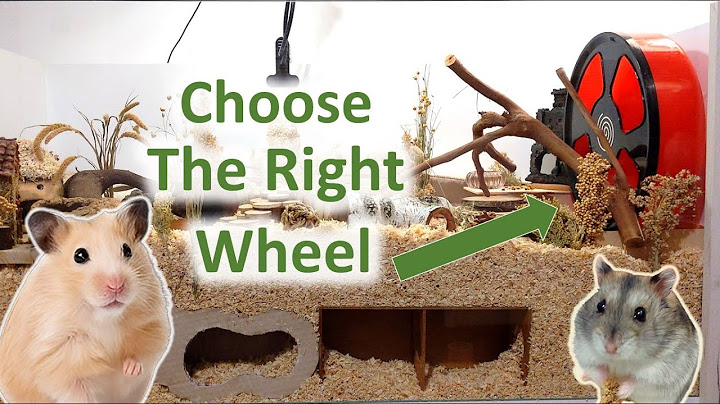
Hamster wheel size chart by species
The Blue Cross recommendations below are species-specific ranges, while PDSA states broader minimums. Centimeter and inch conversions are approximate. A hamster should not be forced to use a wheel that produces a curved back simply because the model falls inside a suggested range.
| Hamster species | Blue Cross guidance | Approximate inches | PDSA reference |
| Syrian | 27–32 cm | 10.6–12.6 in | At least 30 cm |
| Campbell's dwarf | 22–25 cm | 8.7–9.8 in | Dwarf: at least 20 cm |
| Winter white dwarf | 22–25 cm | 8.7–9.8 in | Dwarf: at least 20 cm |
| Roborovski | 20–22 cm | 7.9–8.7 in | Dwarf: at least 20 cm |
| Chinese hamster | 25–27 cm | 9.8–10.6 in | Dwarf: at least 20 cm |
PDSA's Syrian threshold is more conservative than the lower end of the Blue Cross range. For a Syrian buying a new wheel, 30 cm or larger is the simpler practical starting point, then confirm fit. For a dwarf hamster, consider both the Blue Cross species range and the animal's actual posture rather than buying the minimum indiscriminately.
Why a few centimeters can matter
The wheel forces a hamster to follow a circular path. On an undersized wheel, the spine may arch and the head may be held unnaturally high. Welfare organizations warn that too-small wheels can cause discomfort and potential long-term problems. Hamsters will sometimes keep using poor equipment, so continued running cannot be treated as proof that the diameter is adequate.
Wheel labels may advertise a 6-, 8-, 10- or 12-inch size. That number does not explain whether it describes the outer shell, the internal running track or an approximate product dimension. Measure the usable running diameter when possible. A 12-inch outer housing is not necessarily a full 12-inch running track.
How to measure a hamster wheel correctly
Measure across the usable running circle from one inner edge of the track to the opposite inner edge, passing through the center. Keep the tape straight, not along the curve. If the manufacturer gives only exterior dimensions, ask for the interior running diameter. Measure the track width separately: the hamster must be able to run without rubbing its sides or falling off a narrow rim.
Then measure the space the full wheel requires: wheel diameter, stand height and room above the deep bedding platform. A wheel that fits only after reducing safe bedding to a thin layer is not a satisfactory enclosure solution. Raising it onto a stable surface or selecting a taller, larger home is better than sacrificing burrowing space.
Straight-back posture test for real-world fit
Observe your hamster during normal evening activity. At a comfortable pace, the body should remain fairly straight rather than forming a marked upward arch, and the head should not tip dramatically to accommodate the circle. Check whether the hamster takes normal strides, remains centered on the running surface and enters without stumbling.
A dwarf hamster using a wheel larger than the minimum is not automatically in danger: what matters is whether it can start and stop the rotation and maintain its footing. If the wheel is heavy or awkward for the individual animal, a different model may be appropriate. Consult an exotics veterinarian if abnormal posture or signs of pain persist even after equipment changes.
What is different about Syrian hamster sizing?
Syrians are often larger-bodied than the small dwarf species. A wheel selected only because it worked for a Roborovski may be far too small for a Syrian. Starting with 30 cm is consistent with PDSA guidance and leaves room for many adults to run more naturally, though some individuals may benefit from a larger suitable model. A full Syrian wheel selection checklist covers stability, tread width and enclosure clearance for these larger wheels.
Syrian recommendations also illustrate why one universal wheel-size answer is misleading. Blue Cross states 27–32 cm for Syrian hamsters and PDSA says at least 30 cm, so the documents are not numerically identical. Rather than hide this difference, treat both as guidance and use the straight-back observation to decide whether the actual wheel works.
What about Roborovski and Chinese hamsters?
Roborovskis are small, but their size does not justify tiny wheels with bars or poor traction. Blue Cross lists 20–22 cm for Roborovskis, and the same rules about a solid running surface and secure stand apply. A Chinese hamster is longer-bodied than many people expect; Blue Cross lists 25–27 cm. Buying a wheel solely because the store calls it "dwarf-sized" can therefore be misleading.
For Campbell's and winter white dwarf hamsters, Blue Cross gives 22–25 cm. Those are usable shopping ranges to discuss, not mandatory upper limits. An individual hamster's movement, balance and ability to rotate the wheel safely remain the deciding evidence.
Diameter is only part of safety
Even a perfectly sized wheel is not appropriate if it has exposed bars, wire mesh, unstable mounting, rough seams or a very narrow track. Choose an upright wheel with a continuous surface and good grip. Position it on a stable platform so bedding cannot catch the edge, and check that it remains accessible after the hamster reorganizes its habitat.
Use this size-and-fit checklist before you buy or keep a wheel:
Identify the species instead of relying on the broad word "dwarf."
Compare Blue Cross and PDSA guidance, using the more cautious Syrian starting point.
Confirm the usable inside diameter, not only the outside shell size.
Observe a straight back and natural head position during running.
Check tread width, stability, ease of rotation and enclosure clearance.
Frequently asked questions
Is a 6-inch wheel big enough for a hamster?
A 6-inch (about 15 cm) wheel is below the minimums stated by PDSA for dwarf and Syrian hamsters. It is not a sensible primary exercise wheel for those animals.
Is a 10-inch wheel suitable for Syrian hamsters?
Ten inches is about 25.4 cm, which falls below PDSA's 30 cm Syrian minimum and below the lower Blue Cross Syrian range. A larger wheel is the more appropriate starting point.
Can Roborovski hamsters use a 10-inch wheel?
Some may use a larger wheel comfortably if it rotates easily and provides safe traction. Compare it with Blue Cross's 20–22 cm Roborovski guidance and check the individual's actual movement.
Do Chinese hamsters need bigger wheels than other dwarfs?
Blue Cross lists 25–27 cm for Chinese hamsters, compared with 20–22 cm for Roborovskis. Species-specific guidance is more useful than a single generic dwarf hamster label.
How do I know a wheel is too small?
Look for a notably arched back, strained head position or awkward shortened stride. Measure the usable track and compare it with species guidance; replace unsuitable equipment and speak with an exotics veterinarian if discomfort is suspected.