How Does Radiant Heat Transfer Work?
Learn how radiant heat transfer compares with conduction and convection, with everyday examples and a beginner-friendly formula.
How Does Radiant Heat Transfer Work?
SCIENCE EXPLAINED • US ENGLISH • EDITORIAL SNAPSHOT: NOVEMBER 1, 2026
Radiant heat transfer is energy transported by electromagnetic radiation because of a temperature difference. It is one of the three familiar heat-transfer mechanisms, alongside conduction and convection. Unlike conduction and convection, thermal radiation does not require direct contact or moving air: it can carry energy through the vacuum between the Sun and Earth.
Radiation: heat carried by electromagnetic waves
| Mechanism | Needs matter? | Everyday example |
| Conduction | Yes | Metal spoon warming |
| Convection | Yes, moving fluid | Warm air rising |
| Radiation | No | Sunlight crossing space |
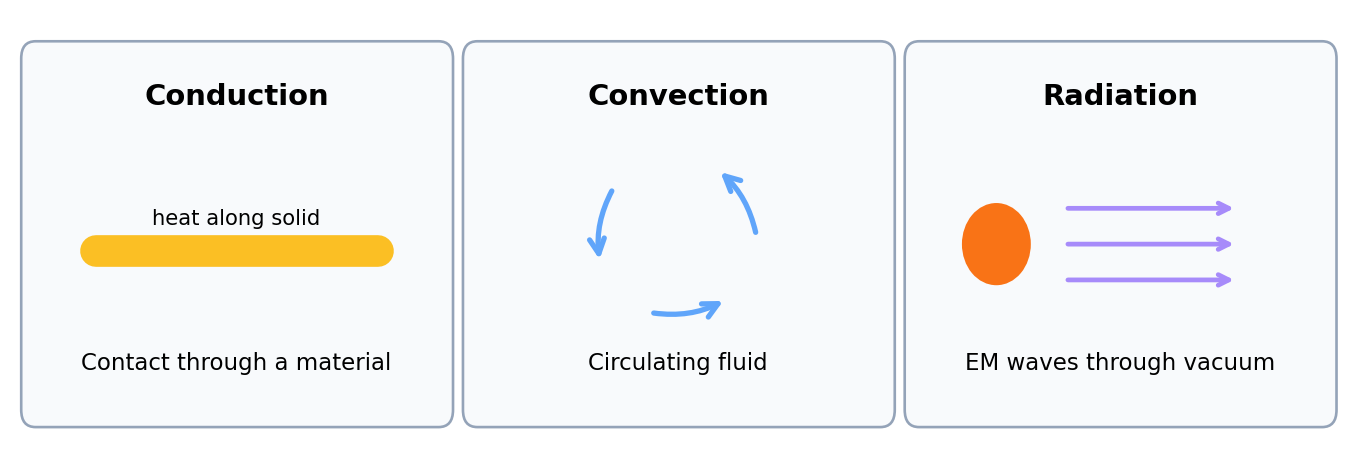
Original educational illustration (schematic; not to scale).
Every object above absolute zero emits electromagnetic radiation, with a spectrum that depends on temperature and material properties. A warm object may emit mostly infrared radiation, while much hotter objects can emit appreciable visible light. Heat transfer occurs when one object absorbs more radiant energy from its surroundings than it emits back, or vice versa.
Infrared is not a synonym for all heat transfer. The amount of energy received depends on surface orientation, emissivity, temperature, view factors, and surrounding objects. For that reason, 'radiant heat always travels in straight lines from a heater to a person' is an oversimplification of real environments with reflections and absorption.
Conduction: heat through matter
Conduction transfers energy through materials because neighboring particles and electrons exchange energy. A metal spoon becoming hot when one end sits in warm liquid is a common example. No bulk fluid needs to move through the spoon; energy propagates within the material. Metals often conduct heat effectively, but their conductivity varies by alloy and temperature.
Conduction can occur in solids, liquids, or gases. It is not limited to direct physical contact between two separate objects: a temperature gradient across one continuous block can produce conduction.
Convection: heat moved by fluids
Convection combines energy transport through a liquid or gas with bulk fluid motion. Warm air rising above a radiator and circulation in a pot of water are familiar cases. Motion may be driven by buoyancy differences (natural convection) or a fan or pump (forced convection). The fluid's speed, geometry, and properties influence how efficiently it transports heat.
The three mechanisms often occur together. A hot mug can conduct energy through its wall, warm nearby air by convection, and emit infrared radiation toward its surroundings.
A simple radiation heat-transfer equation
For an ideal blackbody, emitted radiant power per unit area follows the Stefan–Boltzmann relationship M = σT⁴, where T is absolute temperature in kelvin and σ is the Stefan–Boltzmann constant. For a real surface an approximate emitted power is P = εσAT⁴, where ε is emissivity between 0 and 1 and A is area. The net exchange between simple facing surfaces requires additional terms describing temperature of the surroundings and geometry.
This is why using Celsius directly in a T⁴ expression gives the wrong answer. The simplified expression also is not a complete design calculation for a room or furnace; radiation balance depends on more than one surface's temperature.
Why heat can cross empty space
Vacuum has no air to circulate and essentially no material to conduct through. Yet electromagnetic waves can travel through it. Solar energy therefore reaches Earth mainly through radiation. This principle is used when engineers design spacecraft thermal systems and when scientists analyze the energy balance of planets.
Why surface finish changes radiant exchange
Two objects at the same temperature need not radiate identically at every wavelength. Emissivity depends on the surface and spectral range, so a polished metallic surface and a matte coated surface can exchange different amounts of radiant energy. In practical thermal design, engineers consider emissivity along with airflow, conduction paths, and geometry. This explains why insulation and surface coatings may affect a system in different ways.
Frequently asked questions
Is thermal radiation radioactive? No. Thermal radiation in ordinary environments is predominantly nonionizing infrared; radioactive decay is a nuclear process.
Can radiation and convection happen together? Yes, and they often do around heaters, people, and buildings.
Does the Stefan–Boltzmann formula use Celsius? No. Temperature must be expressed in kelvin.
Explore related science topics
For a closer look at connected concepts, read electromagnetic-wave guide, and radioisotope power for spacecraft.