Sunrise vs. Sunset: What Is the Difference?
Compare sunrise and sunset, including when each happens, the meaning of first and last light, and how the times change.
Sunrise vs. Sunset: What Is the Difference?
Focus keyword: sunset vs sunrise | Editorial gate: READY_EDITORIAL
Sunrise and sunset are paired events at opposite ends of the daylight interval. Sunrise is when the Sun’s upper edge first becomes visible above an unobstructed ideal horizon; sunset is when its upper edge disappears. Both are astronomical events, not synonyms for the entire glow of dawn or dusk.
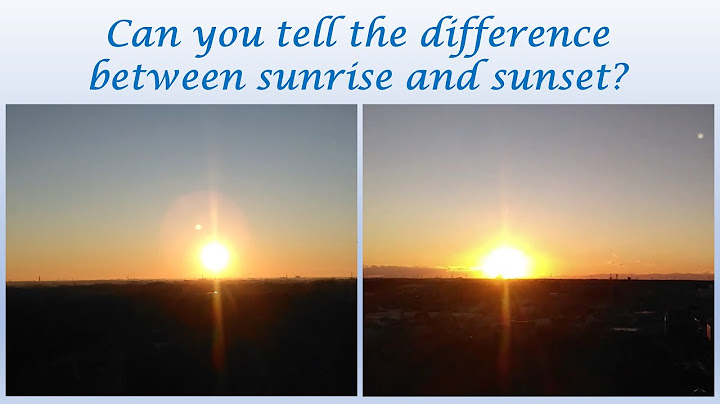
Sunrise vs. sunset at a glance
| Feature | Sunrise | Sunset |
| Position in day | Beginning of daylight period | End of daylight period |
| Horizon event | Upper edge first appears | Upper edge finally disappears |
| Related twilight | Morning civil twilight precedes it | Evening civil twilight follows it |
| Practical use | Planning an early start | Planning evening light and visibility |
Why a bright sky can appear before sunrise or after sunset
Sunlight scatters through the atmosphere even when the Sun itself is below the horizon. In the morning, civil dawn begins before sunrise; in the evening, civil dusk ends after sunset. Those periods should not be counted as the same event as the visible crossing of the Sun’s edge. Clouds, airborne particles, landscape and urban lights make each sky look different.
Atmospheric refraction shifts the apparent moment
Light bends as it travels through the atmosphere, causing the Sun to appear slightly above its true geometric position near the horizon. Standard almanac calculations account approximately for refraction and the Sun’s apparent disk radius. Conditions can vary with pressure and temperature, so a person’s observed moment may not agree to the second with a published table.
How to calculate the daylight interval
For a selected date and place, the interval between the reported sunrise and sunset is the conventional duration of daylight. If a result crosses a daylight-saving transition, calculations should use a robust date/time representation rather than simply subtracting naïve clock labels. Official astronomical services provide day-length tables and can avoid such mistakes.
The phrase “golden hour” belongs to photography rather than the precise almanac definition of sunrise or sunset. Its appearance and duration depend on solar elevation, cloud and local surroundings. For city-specific planning, choose an accurate date and location first; do not reuse another city’s evening-light schedule.
Related: What time does it actually get dark?
Related: Why the Sun rises in the east
Frequently asked questions
Is sunrise always the same amount of time before noon?
No. Solar noon, seasonal day length, longitude and local clock rules affect the interval.
Is sunset the beginning of darkness?
It begins the period after the Sun drops beneath the horizon, but evening twilight continues.
Can sunrise and sunset look different?
Yes. Local weather, aerosols, viewing direction and horizon conditions can produce different colors or visibility.
Editorial references (not outbound hyperlinks): U.S. Naval Observatory rise/set and twilight data; NOAA solar calculator glossary; NIST U.S. daylight saving rules. Verify any dynamic values again before publishing.