What Are the Van Allen Radiation Belts?
Explore the Van Allen radiation belts, their charged particles, inner and outer regions, and why they matter to satellites and astronauts.
What Are the Van Allen Radiation Belts?
SCIENCE EXPLAINED • US ENGLISH • EDITORIAL SNAPSHOT: NOVEMBER 1, 2026
The Van Allen radiation belts are two broad, changing regions of energetic charged particles trapped around Earth by its magnetic field. They are not solid rings, and they are not barriers a spacecraft can never cross. Understanding what fills the belts, why the particles stay there, and how their intensity varies explains both a major discovery of the space age and a practical problem for satellite engineers.
Where the radiation belts are—and where they are not
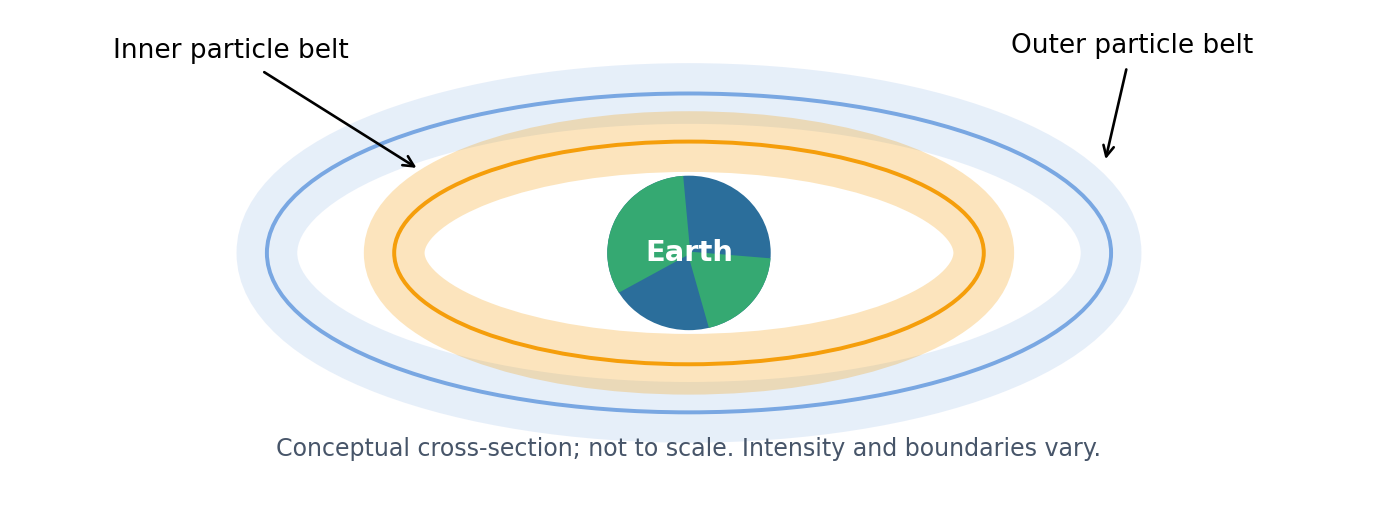
Original educational illustration (schematic; not to scale).
Earth has a magnetosphere: a vast environment shaped by its magnetic field and charged particles flowing from the Sun. Within it, electrons and protons can become trapped on magnetic field lines and form radiation belts. In a simplified drawing the belts look like nested doughnuts, but the actual particle populations depend on location, energy, magnetic activity, and time. Unlike an atmospheric layer, the belts cannot be described by one fixed altitude or perfectly sharp edge.
The inner region is comparatively persistent and contains high-energy protons as well as electrons; the outer region is especially well known for energetic electrons that change rapidly when space weather becomes disturbed. The belts are far above the surface: they do not make ordinary ground-level travel hazardous. The often-repeated idea that the belts consist mainly of gamma rays is mistaken. Their defining populations are charged particles, while gamma rays are electromagnetic photons.
Why particles become trapped
A charged particle moving through a magnetic field experiences a force that bends its path. Many trapped particles spiral around magnetic field lines, bounce between magnetic mirror regions in opposite hemispheres, and drift around the planet. Together these motions keep some particles confined for a time rather than allowing them to fly away in a straight line.
That does not mean every particle stays forever. Interactions with plasma waves, changing magnetic conditions, and the upper atmosphere can accelerate, scatter, or remove particles. The solar wind continually affects Earth's magnetic environment, so the density and energy of belt particles rise and fall. Scientists use space-based instruments and models—not one permanent cross-section—to describe those variations.
Inner belt vs outer belt
The inner belt is generally more stable and includes a significant population of trapped energetic protons. The outer belt is more variable, with high-energy electrons that can intensify or diminish during geomagnetic disturbances. Between the main electron belts there is often a lower-density 'slot' region. These are useful generalizations, not rigid boundaries: energetic electron and proton populations overlap and have different spatial distributions.
NOAA emphasizes that radiation-belt changes can occur on scales from minutes to years. A quiet-day diagram may therefore look very different from observations collected after a strong solar storm. Some particles originate through interactions involving cosmic rays and the atmosphere; others are strongly influenced by solar-wind and magnetospheric processes.
The temporary third belt scientists observed
In 2013, NASA reported that instruments on its Van Allen Probes had observed an additional, temporary radiation-belt structure. That finding was important precisely because the usual description includes two persistent zones. The observation did not establish three unchanging rings around Earth; it showed how complex and dynamic trapped-particle populations can be.
What the belts mean for satellites and astronauts
Energetic particles can upset electronics, degrade materials, interfere with sensors, and increase radiation exposure in space. Engineers choose components, shielding, trajectories, and operating procedures with the relevant particle environment in mind. A satellite that repeatedly crosses active regions may face a different design challenge from one that remains mostly below them.
NASA's Apollo 8 mission traveled beyond the belts on its way to the Moon in 1968. Crewed missions plan exposure using route, speed, measured radiation conditions, and spacecraft protection; the existence of the belts does not by itself make lunar travel impossible. The practical question is accumulated exposure along a specific route, not whether an imaginary solid wall must be broken.
Frequently asked questions
Who discovered the Van Allen belts? They were identified in 1958 through early satellite measurements associated with physicist James Van Allen and his collaborators.
Are the belts always the same size? No. Energetic particle populations and their intensity respond to changing conditions in the magnetosphere.
Is the radiation mostly gamma radiation? No. Energetic charged particles, notably electrons and protons, define these belts. Gamma photons are a different physical kind of radiation.
Explore related science topics
For a closer look at connected concepts, read electric and magnetic fields; gamma-ray fundamentals, and radioisotope power for spacecraft.