What the Backrooms Mean in Internet Horror
Define Backrooms, the viral liminal-space horror idea, and see how its original post, fan levels, videos, games, and movie differ.
What the Backrooms Mean in Internet Horror
The Backrooms are a collaborative internet horror setting built around an unnerving idea: a person slips out of ordinary reality and becomes lost in spaces that look almost familiar, but never quite make sense. The original story suggested a seemingly endless complex of empty, yellow rooms. Since then, different writers, filmmakers, and game developers have built their own versions of what lies beyond that first room.
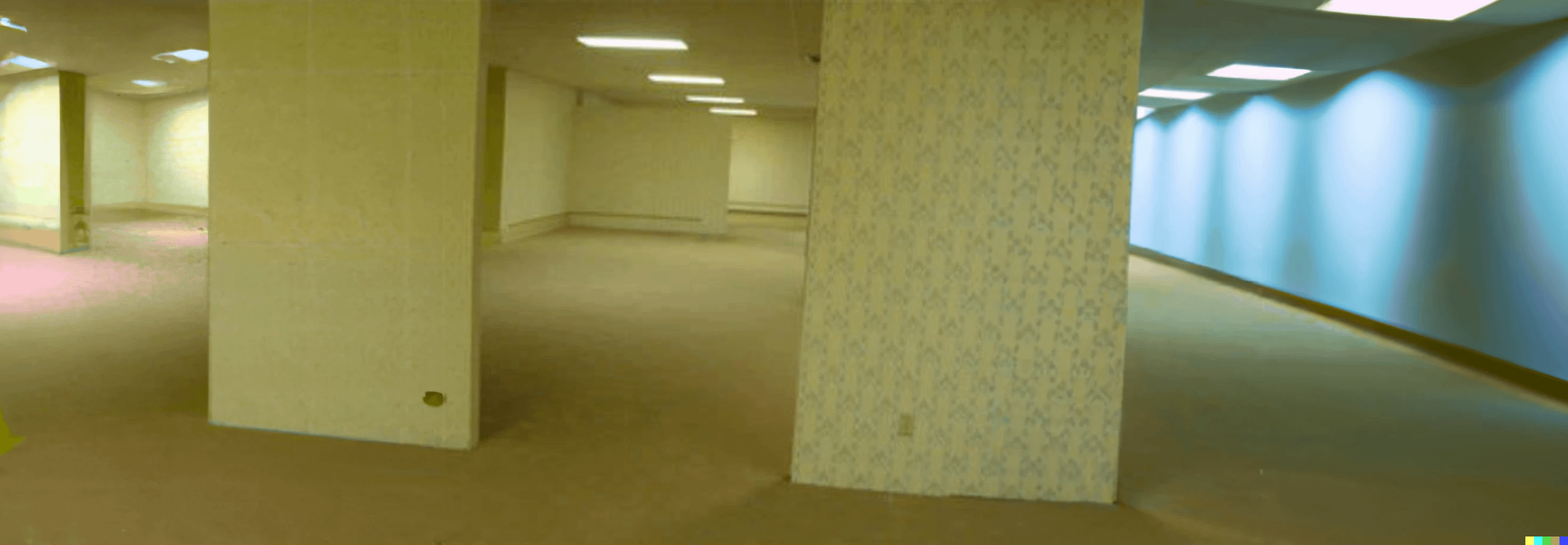
How a photograph became an internet legend
The idea became widely known through a May 2019 post on 4chan. A photograph of a deserted interior was paired with a short description of accidentally “no-clipping” out of reality. In video-game language, no-clipping means passing through a boundary that should stop a character. The post borrowed that familiar gaming concept and turned it into a disturbing explanation for getting stranded somewhere impossible.
The photograph was not evidence of another dimension. Researchers later traced it to a real renovation scene in Oshkosh, Wisconsin. What made the pairing memorable was the contrast: fluorescent lights, stained carpet, and routine architecture acquired a sense of dread through a few sentences of fiction.
Why an empty hallway can be frightening
A liminal space is a place associated with passing from one activity or location to another: a corridor, waiting room, stairwell, or hallway. Such places can feel unsettling when people and normal signs of activity disappear. The Backrooms exaggerate that mood with repetitive rooms, wrong proportions, and a lack of reliable exits.
Unlike a conventional haunted house, the threat need not arrive as a monster. The space itself asks troubling questions. How long has someone been walking? Is that the same corner as before? Why does the building resemble an office without ever functioning as one? The setting leaves room for the reader's imagination to supply answers.
There is more than one Backrooms continuity
Community fiction expanded the concept into numbered levels, invented entities, and elaborate travel logs. These entries are made by different contributors, and details may vary between websites or revisions. A level described one way in a fan wiki is not necessarily the same location seen in a video or a commercial game.
Kane Parsons, known online as Kane Pixels, created a found-footage interpretation with its own imagery and story conventions. The A24 film released in 2026 is another adaptation. Escape the Backrooms is a cooperative video game with playable objectives, not a definitive rulebook for the wider fiction.
Where to begin exploring
For the real-world origins, start with the original photograph and its history. For fictional geography, choose a community-wiki continuity and read its individual levels. View the Kane Pixels videos as a separate screen narrative, and approach games as interactive reinterpretations. Keeping those lanes distinct makes the Backrooms more interesting: one strange internet image has inspired several kinds of horror without requiring them to agree on every fact.
Frequently asked questions
Is there an official Backrooms timeline?
Not one that controls every adaptation. The 2019 post is an important point of origin, but community writers, Kane Pixels, games, and the feature film develop different stories. A timeline makes sense only after naming which continuity it follows.
Why do people call some rooms liminal?
The word points to spaces normally used between destinations, such as corridors or empty waiting areas. Backrooms fiction makes these familiar in-between environments feel permanent, as though the next destination has disappeared.
Related Backrooms guides
Is the Backrooms a Real Place or an Internet Story?