Black Soldier Fly: Life Cycle, Larvae, Composting, and Uses
Black Soldier Fly. Explain Hermetia illucens and its larvae in waste processing; avoid pet feeding dosage.
Black Soldier Fly: Life Cycle, Larvae, Composting, and Uses
The black soldier fly, Hermetia illucens, is a fly whose larvae are known for processing decaying organic matter.
The insect behind the name
The adults are dark and wasp-like in appearance but are not mosquitoes. Most resource-recovery discussions focus on the larval stage rather than on adult feeding behavior.
Egg, larva, pupa, adult
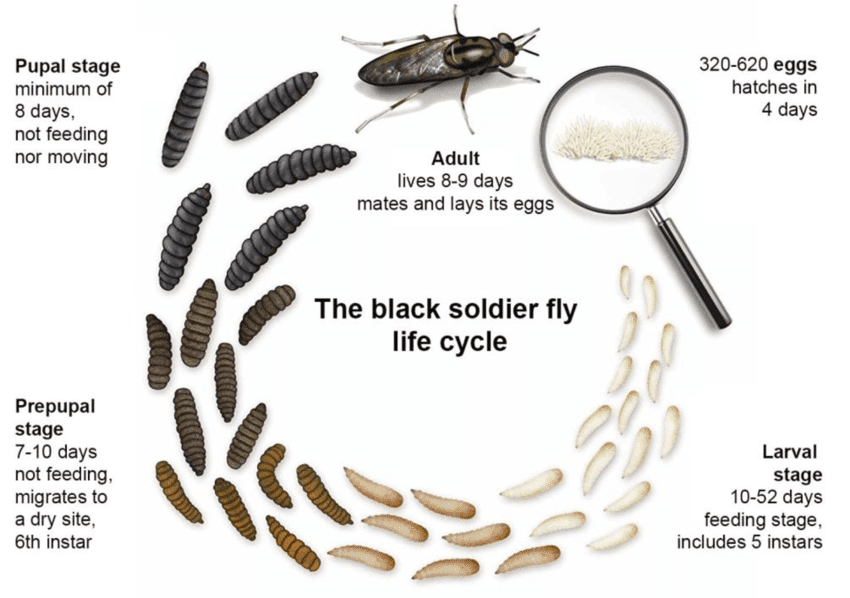
Females lay eggs in suitable locations near organic material. Larvae feed and grow through several stages, then seek drier places to pupate. The exact development time depends strongly on temperature, moisture, and feed composition. A facility’s output figures cannot be generalized to every climate.
Composting and circular systems
Larvae can reduce the mass of certain food and agricultural wastes while producing insect biomass and residual material called frass. Such systems require careful control of substrates, sanitation, pests, and applicable waste regulations. Larval feeding does not magically eliminate all contaminants or pathogens.
Use in animal feeds
Processed black soldier fly larvae are studied and used in some regulated feed systems, but ingredient suitability depends on species, formulation, and processing. Avoid prescribing live-larva serving amounts for reptiles or poultry from a generic article. Feed-safety standards and product labeling matter.
The waste stream changes the result
A black soldier fly larva raised on clean, approved material cannot be assumed equivalent to a larva feeding on a contaminated waste stream. Feed substrates influence the insects and the residue they leave behind. For commercial operations, temperature, moisture, waste separation, and local regulation shape whether an approach is safe and economical. The larvae can be useful in circular-resource systems, but they should not be described as guaranteed sterilizers of waste or as a universal answer to livestock feed costs.
What a useful field note records
When observing birds or insects, write down location, season, appearance, food source, and behavior. Those details often separate similar-looking species and life stages. If an animal is being managed in captivity or on a farm, welfare and hygiene requirements need their own expert guidance; wild behavior is not a ready-made care plan.
From life history to responsible observation
An animal may behave differently as an egg, larva, juvenile, or adult, and seasonal changes may affect how easy it is to see. A species described as beneficial in one setting can be a pest or prey item in another. Use photographs and field notes without disturbing nests, colonies, or habitat. Where keeping or feeding animals is involved, follow the guidance appropriate to that exact species and local rules, not a general wildlife description.
Frequently asked question
Do black soldier flies bite people?
Adults are not blood-feeding mosquitoes; routine concern in managed systems centers on sanitation and substrate quality.
