Dog Steps for Cars: Choosing Stable Vehicle Access
Compare dog steps for cars by door and cargo height, stair angle, grip, portability, secure placement and dog size.
Dog Steps for Cars: Choosing Stable Vehicle Access
Dog steps for cars are portable stair assemblies intended to help a dog reach a vehicle entry point without a single large leap. They are different from indoor bed stairs because vehicle access introduces uneven parking surfaces, door openings, changing threshold heights and the need to secure or stabilize the equipment before every use. A staircase that works beautifully beside a sofa may be unsuitable at an SUV cargo hatch.
Measure the actual vehicle opening while safely parked, then compare the usable step geometry, ground-contact design and manufacturer instructions. Consider your dog's movement and whether a continuous ramp would be more practical. For dogs with mobility restrictions or spinal pain, consult a veterinarian before using any loading aid.
Measure the correct entry threshold
Start with the exact place your dog will enter: rear cargo floor, hatch opening, back seat footwell or side door. The relevant height is the vertical rise from the parking surface to the stable surface where the dog's paws must land, not an advertised vehicle "ride height." Different doors on the same vehicle can have very different step-over heights and landing spaces.
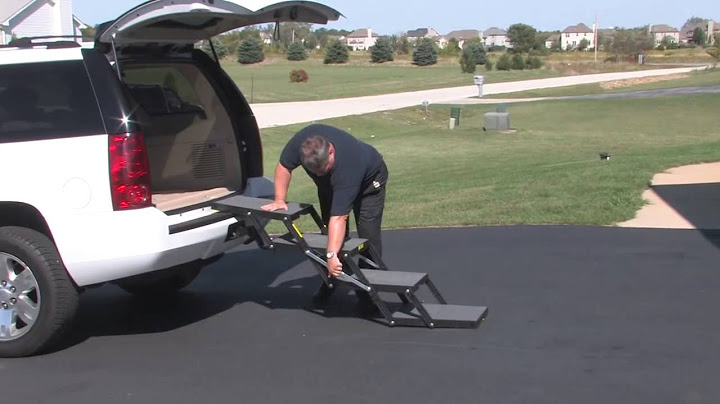
Park on a level, legal surface with the vehicle secured and engine off. Measure from ground to the target landing. Account for a raised bumper, cargo lip or trim piece that the dog must step over after reaching the final stair. If the cargo floor is higher than the lip, note both measurements. A staircase that ends at the bumper but requires another uncomfortable jump into the cargo bay has not solved the whole access problem.
Also record door opening height, available width and whether a hatch, door hinge or swing path obstructs the unit. If the product will be used in multiple cars, measure each one separately. Do not copy dimensions from a similar model year found online, because tire size, suspension and trim can affect practical entry height.
Match the stair footprint to the parking area
Unlike a bed, a vehicle does not always park in the same environment. Your steps may need to stand on asphalt, concrete, packed gravel or a damp surface. Manufacturers may restrict use on sloped or uneven ground. Check the number and type of ground-contact feet, whether the base can sit flat, and whether one foot can sink into soft ground. Avoid deploying on mud, loose stones or a steep roadside slope.
Measure the staircase when fully extended, including how far it projects behind or beside the vehicle. Think about the space where the dog must line up before stepping onto the first tread. Parking next to a wall, curb or another car may leave too little room. A long product might fit at home but be hard to set up in a crowded parking lot.
The safest setup is a predictable straight approach with enough clear space for the dog and handler. A crowded doorway, narrow shoulder or heavy traffic is a reason to choose a different loading location rather than improvising a precarious stair angle.
Compare step rise, tread depth and top connection
Each tread must offer usable paw space. Narrow slats or steep risers can make a dog scramble, while an inadequate upper landing may leave a final hop to the cargo floor. Compare the manufacturer's individual tread dimensions as well as total stair height. A product label like "SUV stairs" does not establish that every SUV opening and every dog will fit.
Pay close attention to how the upper end meets the vehicle. Some purpose-built designs use straps, hooks or support brackets specified by the manufacturer; others depend on a particular bumper or cargo threshold shape. Do not attach a product to trim, plastic panels or seat components unless the instructions expressly permit it. The connection should not slip when the dog shifts weight during entry or exit.
A vehicle may settle slightly with changes in load or suspension. Check positioning before each session rather than assuming the previous fit remains exact. When in doubt, stop using the equipment until the manufacturer clarifies the installation method.
Check anti-slip treads and wet-weather use
Vehicle steps often operate around dust, rain and debris. Look for securely attached traction strips or textured treads that remain usable when conditions change within manufacturer limits. Loose carpeting that curls at the edges can catch claws. Inspect the feet for dirt and wear, and clean them as specified. A rubberized appearance does not guarantee grip on oily or wet pavement.
Avoid encouraging a dog to hurry up or down the steps in bad weather. Let the dog pause if needed while you maintain supervision without pulling on its collar. If the manufacturer says the steps are not intended for wet use, follow that restriction. Never use the stairs in a moving vehicle or leave them deployed where they obstruct other road users.
Verify the rated load and locking system
Use a unit specifically rated for your dog's weight and the intended vehicle loading scenario. Confirm the instructions for assembly, spreader braces, straps and any locking mechanism. Extending legs or telescoping sections without fully engaging a latch can leave the structure unstable. Recheck locks after transporting and unfolding the stairs.
Inspect hinges, rivets, joints and feet regularly. Do not substitute an improvised strap or wedge for a missing manufacturer part. Do not let children or multiple dogs crowd onto a stairway built for one animal. If the stairs rock or deform with normal supervised use, stop immediately.
For people comparing portable designs for indoor furniture rather than vehicles, see folding dog stairs. The two settings should not be treated as interchangeable merely because both products can fold.
Teach vehicle entry and exit separately
Begin with the stationary staircase on a level surface before asking the dog to enter a vehicle. Reward approach, investigating the first tread and a calm climb one step at a time. Follow the equipment instructions for a practice setup; avoid attaching it to the vehicle incorrectly just to train. Use non-slip rewards or a hand target rather than pulling the dog upward with a leash.
For the vehicle session, secure the car, place and inspect the steps, then invite a calm ascent. Observe the descent separately: a dog may leap out even after climbing in confidently. Keep the dog under control while you prevent access to traffic. Consider a well-fitted harness if recommended by your veterinarian for handling, but do not use it to suspend an unsupported dog unless it is specifically designed for that purpose.
When car steps are not the best option
Some dogs are more comfortable walking on a continuous canine ramp instead of negotiating separate risers. Ramp fit depends on usable length, inclination, traction and safe connection to the vehicle. A short ramp may still be too steep for a high cargo floor. Other dogs need assistance or a lower access point, and some should avoid climbing during recovery.
For a larger dog, remember that weight capacity and tread width remain essential; the large-dog steps guide covers paw fit and structural support in more depth. Dogs displaying weakness, back pain, dragging paws or sudden hesitation should receive veterinary assessment. Do not turn loading practice into a test of whether the dog can push through discomfort.
Vehicle access comparison worksheet
| Item | Measure or verify | Common mismatch |
| Entry point | Ground-to-cargo or seat landing height | Measuring only the bumper |
| Opening | Door width, hatch clearance and trim | Stairs block the hinge or door |
| Ground | Foot contact and slope restrictions | One foot floats or slips |
| Treads | Usable width, depth and individual rise | Dog scrambles on narrow slats |
| Attachment | Approved support points and locks | Improvised contact on weak trim |
| Transport | Folded size, carry weight, storage | Cannot store the unit safely |
Save the manufacturer's assembly document with your measurements. Compare a loading aid in both directions and allow for the space your handler needs. An item that fits the car on paper but cannot be deployed safely in your normal parking environment is not a good purchase.
Common mistakes with car-loading stairs
Avoid buying based only on a stock photo showing a staircase behind a generic SUV. Do not assume that traction indoors translates to wet asphalt. Do not deploy steps on a roadway side when there is safer access elsewhere. Do not allow the dog to jump from the final tread because the landing is misaligned. And do not leave the stairs in the car unsecured where they can become a projectile during driving.
A stable routine matters: park, secure the vehicle, clear a safe area, fully deploy, check the attachment and feet, guide the dog, then fold and stow after the dog is secure. Skipping one stage creates avoidable uncertainty.
Frequently asked questions
Can I use bed stairs to help my dog get into an SUV?
Not unless the manufacturer explicitly approves vehicle use and the design has appropriate ground contact and attachment. Indoor steps usually lack vehicle-specific stability provisions.
How tall should dog car stairs be?
Measure ground to the exact entry landing on your parked vehicle and compare that measurement with the product's top usable step height and attachment method. There is no one-size-fits-all SUV height.
Do car stairs work on gravel?
Only if the product instructions permit the surface and the feet remain level and stable. Uneven or loose ground may prevent safe deployment; relocate the vehicle when possible.
Are steps better than a ramp for a large dog?
Neither is universally better. Steps require negotiating risers; ramps require enough length for a manageable slope. Dog mobility, paw fit, surface and veterinary guidance determine the preferable route.
Why will my dog climb into the car but not climb out?
Descending can feel different because of visibility, step orientation, fatigue or discomfort. Practice the two directions separately and avoid forcing the dog. Seek veterinary advice if hesitation is new or accompanied by pain.