How Do Black Holes Form? Stellar Collapse Explained
Black holes can form when massive stars collapse. Learn which stars qualify, how supernovae fit in, and how supermassive black holes differ.
How Do Black Holes Form? Stellar Collapse Explained
Many black holes form when very massive stars reach the end of their lives and their cores collapse under gravity. Not every dying star becomes a black hole: the starting mass, core structure, mass loss, and details of the collapse determine whether the remnant is a white dwarf, neutron star, or black hole.
The life of a massive star before collapse
A massive star fuses lighter elements into heavier ones in its core. This produces pressure that helps oppose gravity. Late in the star's life, its core can develop an iron-rich composition: ordinary fusion of iron no longer supplies the energy needed to support the central layers.
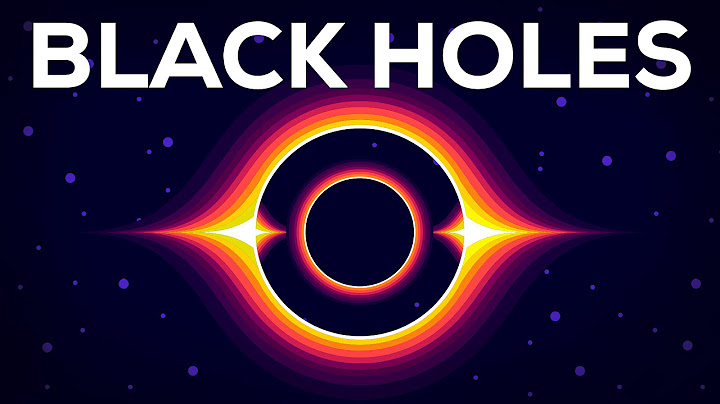
Without sufficient pressure, gravity wins. The core rapidly contracts. Some collapsing stars explode as supernovae, leaving a compact remnant. Others may experience substantial fallback or collapse with a comparatively faint outward explosion; the details depend on how much material is ejected.
When collapse produces a black hole
If enough mass becomes concentrated inside a sufficiently small region, an event horizon forms. Light emitted from within that horizon cannot escape to distant observers. The black hole's mass is not necessarily the mass the star had when it was born; winds, explosions, and binary interactions can remove large amounts of matter.
A lower-mass star like the Sun will not become a black hole by the normal stellar-evolution route. A familiar misconception is that every bright star ends with a singularity; stellar lifetimes and fates vary enormously.
Other ways black holes can grow
Two compact objects can merge and form a heavier black hole. Astronomers detect some such mergers through gravitational waves measured by observatories including LIGO and Virgo. Existing black holes may also gain mass from gas or companion stars, sometimes producing radiation from very hot surrounding material.
Supermassive black holes at galactic centers are a separate formation problem. Early seeds, sustained feeding, and mergers are all studied, but a complete explanation of how the earliest giants grew so fast remains an active research question.
What observations reveal the process
A telescope cannot normally watch a black hole's interior. Instead, researchers infer formation channels from compact-binary masses, the motions of companion stars, supernova remnants, and gravitational-wave signals. Different mass and spin patterns can favor different histories, even when an individual object's past is uncertain.
The formation story should not be confused with whether a black hole is dangerous to Earth. Gravity behaves normally at large distances; a black hole is not a roaming vacuum cleaner that pulls everything in from unlimited range.
Frequently asked questions
Can the Sun eventually become a black hole?
No. It lacks the mass required for a standard core-collapse black-hole remnant.
Does every supernova make a black hole?
No. Some supernovae leave neutron stars, and the outcomes depend on the progenitor and explosion.
Are supermassive black holes made by one ordinary star?
No. Their growth likely involves seeds and long histories of accretion and mergers.
Related reading
What Is a Black Hole? Space, Gravity, and Common Myths