How Many Galaxies Are in the Observable Universe?
The number of galaxies depends on telescope limits and methods. Explore published estimates and why the universe contains more than we can see.
How Many Galaxies Are in the Observable Universe?
There is no exact, final census of galaxies in the observable universe. Astronomers can directly catalog many billions, while model-based estimates that correct for extremely faint, distant galaxies have reached roughly two trillion. The difference reflects what is counted and what is inferred—not a sudden multiplication of galaxies.
Why scientists quote different totals
NASA has explained that the observable universe contains at least 100 billion galaxies, a deliberately conservative statement. A 2016 analysis of very deep Hubble observations inferred about two trillion after correcting for small, dim galaxies that the telescope could not detect individually. The latter is a model-dependent estimate, not two trillion distinct objects photographed one by one.
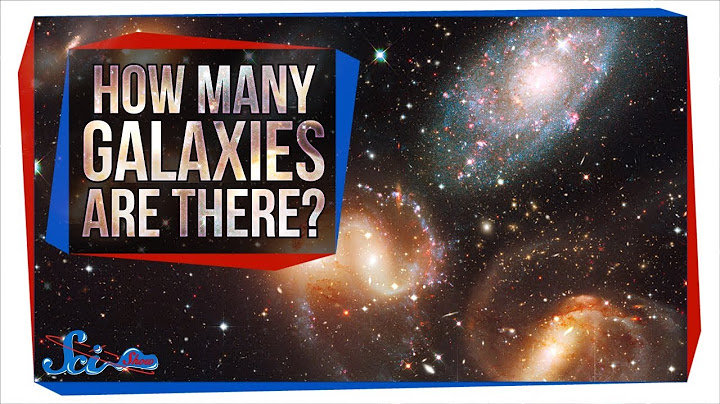
Subsequent research using sky brightness, infrared observations, and other data tests the assumptions behind faint-galaxy populations. The result is better described as a scientifically constrained range than as one timeless exact figure.
Observable universe versus the whole universe
The observable universe is the region whose light has had enough time to reach us since the Big Bang, taking cosmic expansion into account. We do not know the full spatial extent of everything beyond that horizon. A galaxy count for the observable region cannot be extended mechanically to an unknown whole universe.
This distinction matters whenever a headline claims that researchers have counted every galaxy in existence. Even the best telescope samples only particular wavelengths, distances, brightness levels, and portions of sky.
How deep-field surveys work
Astronomers point telescopes at seemingly blank pieces of sky and integrate light for many hours. The images contain tiny galaxies that ordinary exposures miss. Scientists estimate their brightness, distance, and redshift, then statistically correct for populations too faint or too small to resolve.
A correction based on an assumed luminosity function can greatly change the inferred total. Nearby bright spirals, faint early galaxies, and merger remnants are also not equally easy to classify, so the definition of one galaxy matters.
Why Webb does not simply settle the number
The James Webb Space Telescope excels at examining faint, redshifted sources, especially in infrared light. It can revise our understanding of early galaxy formation and help constrain populations that Hubble struggled to see. But observing a deeper field is not the same as surveying every direction at unlimited sensitivity.
A useful article should tell readers which estimate it cites, when it was published, and whether it is an observed lower bound or an extrapolation. That is more informative than presenting a dramatic large number without the method.
Frequently asked questions
Are there exactly two trillion galaxies?
No. That is one influential model-based estimate for the observable universe, not a complete census.
Does the Milky Way count as a galaxy?
Yes. Our home galaxy is one among the many galaxies in the observable universe.
Will the number change?
Almost certainly: improved surveys, definitions, and faint-galaxy models can change estimates.
Related reading
Galaxy vs. Universe: What Is the Difference?
What Galaxy Do We Live In? Earth in the Milky Way