Invasive Lizards in Florida: Which Species Matter?
Identify invasive lizards in Florida, including green iguanas. Learn how nonnative species differ from native lizards and where to check official guidance.
Invasive Lizards in Florida: Which Species Matter?
FLORIDA WILDLIFE GUIDE • Editorial review: November 2, 2026 • US English
Florida supports both native lizards and a growing variety of reptiles introduced by people. But “seen in Florida,” “nonnative” and “invasive” do not mean exactly the same thing. A nonnative animal occurs outside its historical range; an invasive population has ecological or economic impacts that make management a concern. Understanding these distinctions helps residents identify a visitor, avoid harming native wildlife and report potentially significant sightings. This guide focuses on introduced lizards and their impacts rather than acting as a complete field guide to every small backyard species.
Why Florida has so many introduced reptiles
South Florida's warm conditions, connected urban green spaces, ornamental landscaping and history of cargo transport and the pet trade create opportunities for nonnative reptiles to establish populations. Some arrive as accidental stowaways; others originate from escaped or intentionally released captive animals. A single sighting does not prove a breeding population. Establishment depends on climate, survival, reproduction and access to suitable habitat. Florida researchers and FWC track nonnative species because local populations can expand along canals, road corridors and disturbed environments.
Green iguanas: visible impacts on landscapes
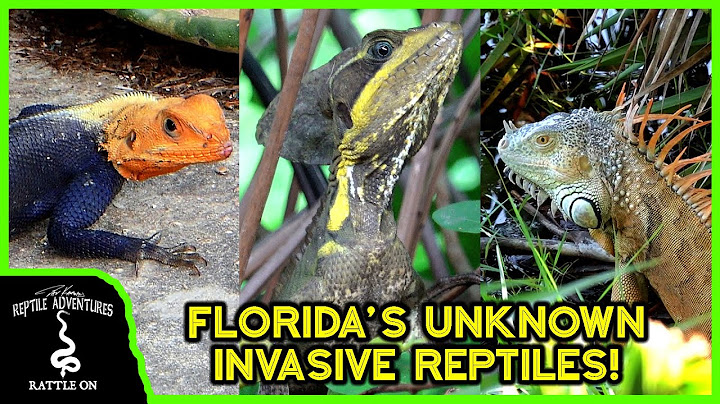
Green iguanas are among the best-known invasive lizards in South Florida. FWC reports grazing on ornamental plants and burrows that can affect sidewalks, seawalls, embankments and canal margins. Adults may be several feet long including the tail, with a dorsal crest and prominent dewlap; coloration varies from green to dark, orange or brown. They often occupy waterside trees and urban spaces. Their size makes them conspicuous, but appearance alone cannot establish whether a particular animal is a legal removal target on a particular parcel.
Tegus are different from iguanas
The Argentine black-and-white tegu is a stocky, ground-oriented lizard with a banded or mottled pattern, not an iguana with a simple color variation. FWC identifies invasive tegu populations and highlights risks to native wildlife, including predation on vulnerable animals and nests. Because tegus and iguanas differ in habitat, biology and management rules, a report should describe body shape, tail, markings and observed location. Do not rely on an uncertain photo to justify capture or relocation. Where FWC requests sightings, use its current reporting tools.
Smaller introduced species: brown anoles and agamas
Introduced brown anoles are common around Florida patios and gardens. UF/IFAS explains that their presence can influence native green anoles through competition and habitat use, while the ecological story is more complicated than “the brown lizard killed the green lizard.” Peter's rock agamas, sometimes called African rainbow lizards, are another introduced group observed in developed South and Central Florida. Bright orange or blue colors may draw attention, but color alone is a poor identification test. Distinct head shape, posture, markings and region are more reliable together.
Impacts are not equal across species
A large burrowing herbivore can affect landscaping and infrastructure in ways a small insect-eating anole does not. A predator may pressure eggs and native wildlife rather than ornamental plants. Researchers distinguish evidence of local damage from broad statewide assumptions. An introduced lizard can be common and established without every sighting representing an ecological emergency. A responsible article should identify the species, cite the kind of impact documented, and avoid describing all unfamiliar reptiles as dangerous or venomous.
What to do when you see an unfamiliar lizard
Observe from a safe distance; note body length including the tail, color pattern, head shape and habitat. Take a clear photograph if it can be done without approaching or cornering the animal. Avoid feeding reptiles, disturbing nests or transporting them. Check species identification against reputable Florida Museum or FWC materials. For species that FWC actively tracks, follow the current reporting instructions. If a large iguana is causing structural problems, use a qualified wildlife-control operator rather than attempting ad hoc relocation.
Connecting identification with laws and services
Different questions deserve different pages. The Florida Lizards guide gives a visual comparison of common native and introduced species. The Florida Iguana Capture Rules article explains permission, possession and public-land restrictions; the removal-services guide helps with hiring professionals. This article instead answers why some introduced lizards are management priorities and how to avoid confusing ecological status with legal permission. Recheck official rules before publishing: invasive status does not suspend animal-welfare law or allow unauthorized entry onto land.
Frequently Asked Questions
Are all nonnative lizards in Florida invasive?
Not necessarily. “Nonnative” describes origin; “invasive” generally implies harmful impacts or management significance. Verify the status of the species in question.
Are green iguanas native to Florida?
No. FWC classifies green iguanas as nonnative and invasive, especially where established populations affect South Florida habitats.
Is a brown anole the same as a green anole?
No. Brown anoles were introduced, whereas the green anole is native. Their colors can overlap, so use several identifying features.
Should I capture a lizard I cannot identify?
No. Photograph and consult trusted identification resources. Native wildlife and private property protections matter.
Where can I report a notable sighting?
Check FWC's current nonnative wildlife reporting guidance and whether reports are requested for that species or county.
Related Reading
Florida Lizards: A Guide to Common Native and Introduced Species