Pioneer Species: How Ecological Succession Begins
Pioneer Species. Explain primary vs secondary succession with real habitat.
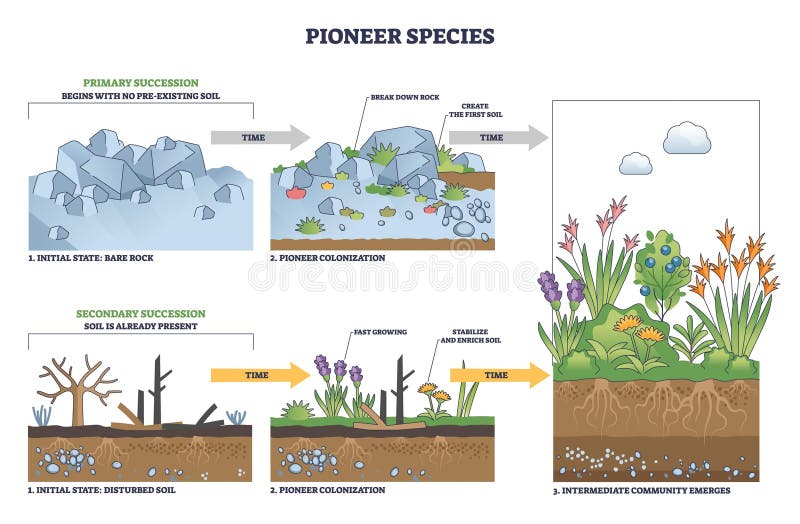
Pioneer Species: How Ecological Succession Begins
Pioneer species are organisms able to establish in habitats where vegetation and biological communities are sparse or recently disturbed.
The first arrivals
Lichens, mosses, grasses, and fast-growing plants may fill pioneer roles, depending on conditions. A pioneer species is defined by ecological function in a setting, not by a permanent species label.
Primary and secondary succession
Primary succession begins on surfaces with little or no developed soil, such as newly exposed rock. Secondary succession follows disturbance where soil or biological material remains, such as after some fires or agricultural abandonment. The likely pioneer community differs because starting resources differ.
Why early colonists matter
Pioneers can trap particles, contribute organic matter, and alter moisture or light, making a site more suitable for other organisms. Succession is not a fixed ladder that always ends in the same forest. Grazing, climate, repeated disturbance, and chance arrivals can change the trajectory.
Recognizing pioneers locally
On an abandoned field, short-lived grasses and herbs may be early colonizers; on bare rock, lichens and mosses may precede vascular plants. Record substrate, disturbance history, and colonization timing before describing a species as a pioneer. One photograph cannot establish the full successional stage.
Succession is not a guaranteed staircase
After a volcanic eruption, a bare surface may offer little soil, while a burned forest often retains roots, seed banks, and nutrient stores. Their first colonists therefore differ. Wind, birds, neighboring vegetation, erosion, and weather can influence which organisms arrive and survive. Although diagrams often show a simple sequence ending in mature forest, repeated disturbance can produce grassland or shrubland for long periods. The term “pioneer” describes a stage-specific role, not a prediction of the final community.
How to apply the definition
Ecological terms are useful only when the observation fits the definition. Record scale, location, substrate, season, and the process being studied. A soil label may describe origin rather than texture; a species label may describe ecological function rather than permanent identity. Compare multiple clues before generalizing from one example.
Evidence, location, and scale
A named ecological process can be real without occurring in the same way in every location. Researchers compare observations across seasons, habitats, and methods, then explain uncertainty. Garden soils, river deposits, natural forests, and farms each have histories that influence the patterns people see. For practical land-use choices, combine the general concept with local data such as soil surveys, climate records, and relevant conservation or agricultural guidance.
Frequently asked question
Are pioneer species always weeds?
No. Lichens, mosses, and native grasses can play pioneer roles depending on habitat and disturbance.
Related guides
Detritivores Explained • Generalist Species vs Specialists • Soil Layers Explained
