Deciduous Forest Plants: Layers, Examples, and Adaptations
Deciduous Forest Plants. Describe seasonal understory, canopy, spring ephemerals and regional.
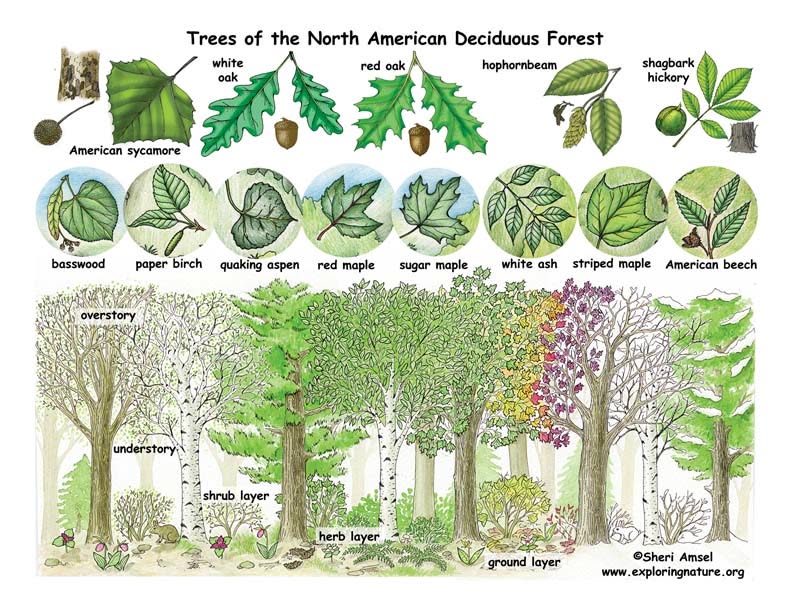
Deciduous Forest Plants: Layers, Examples, and Adaptations
Temperate deciduous forests are dominated by trees that shed leaves during part of the year.
A forest that changes seasonally
In the eastern US, examples include oaks, maples, beeches, and hickories, alongside many shrubs, herbs, vines, mosses, and fungi. The mix changes with region, slope, moisture, and forest age.
The vertical layers
The canopy captures much of the sunlight, while understory trees and shrubs occupy lower levels. The herb layer includes spring wildflowers and seedlings. Forest-floor mosses and leaf litter support decomposers and soil organisms. Plants are shaped by both the light above them and the water below them.
Spring ephemerals
Species such as trilliums and spring beauties may emerge and flower before the canopy fully closes. This short window of light is an adaptation to a strongly seasonal environment. Not every wildflower seen in a deciduous forest is a spring ephemeral, and flowering times differ with latitude.
Responsible field observation
Record canopy species, soil moisture, light conditions, and whether a plant grows along a stream or on a ridge. Avoid removing wildflowers from public lands, and follow site rules. Many woodland plants have lookalikes or protected status; photographs are often a better study tool than collection.
Timing is part of the adaptation
Early-spring herbs use sunlight before most tree leaves emerge, while many understory shrubs tolerate lower light throughout summer. Oak and beech seedlings compete under shade and respond to canopy gaps. Moisture gradients also produce distinct plant communities near streams versus dry ridges. To identify a woodland plant, record flowers, leaves, soil position, and date rather than assuming it grows throughout every temperate forest. Different North American regions support different species assemblages.
How to apply the definition
Ecological terms are useful only when the observation fits the definition. Record scale, location, substrate, season, and the process being studied. A soil label may describe origin rather than texture; a species label may describe ecological function rather than permanent identity. Compare multiple clues before generalizing from one example.
Evidence, location, and scale
A named ecological process can be real without occurring in the same way in every location. Researchers compare observations across seasons, habitats, and methods, then explain uncertainty. Garden soils, river deposits, natural forests, and farms each have histories that influence the patterns people see. For practical land-use choices, combine the general concept with local data such as soil surveys, climate records, and relevant conservation or agricultural guidance.
Frequently asked question
Do deciduous forests contain only deciduous plants?
No. They also support evergreen shrubs, mosses, ferns, fungi, and many other organisms.
