Sandy Loam Soil: Texture, Drainage, and Plant Growth
Sandy Loam Soil. Distinguish texture from soil horizon and explain hand-feel, irrigation and.
Sandy Loam Soil: Texture, Drainage, and Plant Growth
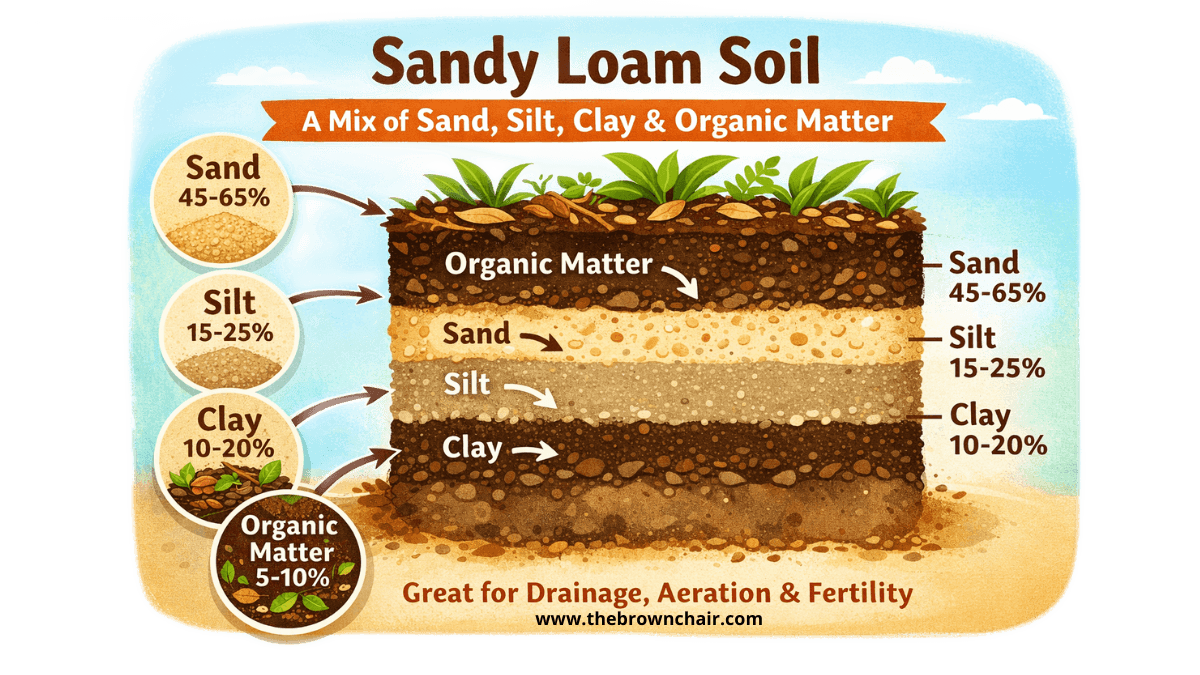
Sandy loam describes the relative proportions of sand, silt, and clay in the fine-earth fraction.
A texture class, not a soil layer
Sand makes up a substantial share, while enough fine material remains to give some cohesion and water-holding ability. It is not the same concept as topsoil or the A horizon.
Drainage and water holding
Sandy loam often drains more readily than clay-rich soils, but organic matter, compaction, soil structure, and underlying layers can change the result dramatically. Water may move quickly through a loose sandy surface and then perch above a dense subsoil. Texture alone does not guarantee good drainage.
Recognizing it by feel
A moist sandy loam commonly feels gritty and forms only a weak ribbon when squeezed. Field texture estimates require practice and can be confused with loamy sand or sandy clay loam. A lab texture analysis is more reliable for decisions involving large investments or engineered soil mixes.
Gardening management
Organic amendments can improve moisture retention and aggregate stability, but they do not transform soil texture overnight. Mulch and irrigation should be guided by plant needs and actual soil moisture. Soil testing helps avoid overfertilizing a sandy site where nutrients may move downward readily.
Texture does not equal fertility
Sandy loam can provide a workable balance for many plants, but it may be low in organic matter or nutrients. A gritty soil that drains rapidly can lose moisture quickly during hot weather. Adding compost may improve structure and water retention without changing the mineral proportions used in texture classification. Irrigation schedules should be adjusted to actual moisture and rooting depth. Soil tests help distinguish nutrient deficiencies from symptoms caused by poor drainage or drought.
How to apply the definition
Ecological terms are useful only when the observation fits the definition. Record scale, location, substrate, season, and the process being studied. A soil label may describe origin rather than texture; a species label may describe ecological function rather than permanent identity. Compare multiple clues before generalizing from one example.
Evidence, location, and scale
A named ecological process can be real without occurring in the same way in every location. Researchers compare observations across seasons, habitats, and methods, then explain uncertainty. Garden soils, river deposits, natural forests, and farms each have histories that influence the patterns people see. For practical land-use choices, combine the general concept with local data such as soil surveys, climate records, and relevant conservation or agricultural guidance.
Frequently asked question
Is sandy loam the same as topsoil?
No. Sandy loam is a texture class; topsoil refers to the surface portion of a soil profile.
Related guides
Soil Layers Explained • Generalist Species vs Specialists • Pioneer Species
