Subsistence Farming: Definition, Types, and Examples
Subsistence Farming. Distinguish subsistence agriculture from commercial systems without.
Subsistence Farming: Definition, Types, and Examples
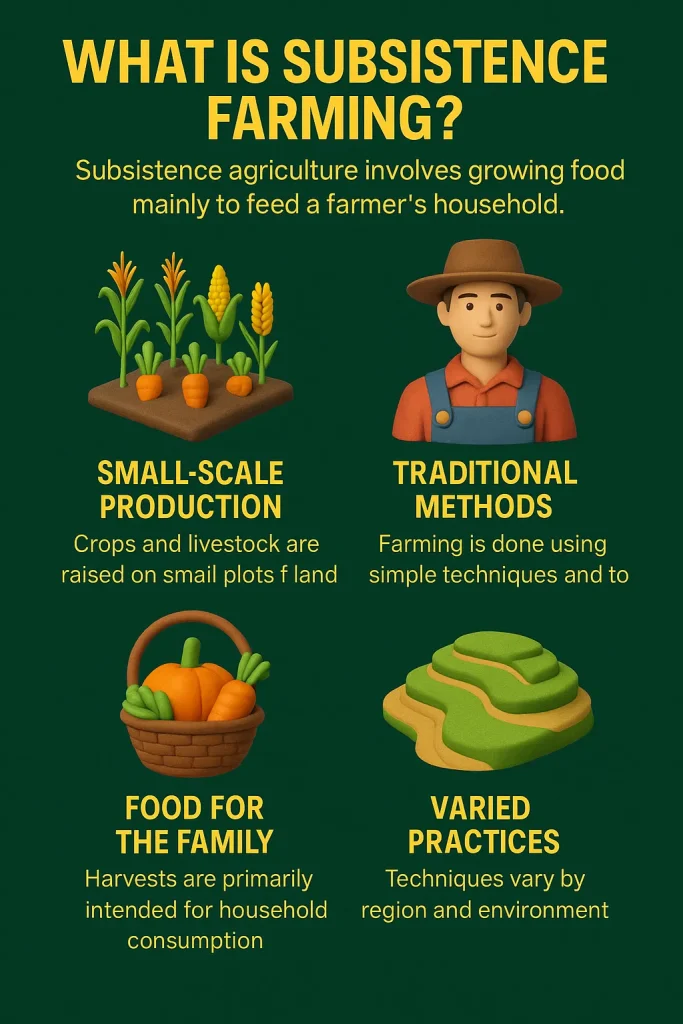
Subsistence farming is agriculture oriented largely toward meeting a household’s own food needs.
Meaning and purpose
Farmers may still sell some surplus, trade products, or earn other income; the term does not require a completely isolated or cash-free farm. Systems differ across climates and cultures.
Common farming approaches
Households may grow several food crops, keep small numbers of livestock, save seed, or combine farming with seasonal work. Crop diversity can spread risk, although it also increases labor needs. A farm’s scale alone does not reveal whether its main goal is household consumption or commercial sales.
Risks and resilience
Subsistence-oriented households can be sensitive to drought, pests, crop failure, land tenure conditions, and access to water. Local knowledge and diversified production may improve resilience, but they do not eliminate vulnerability. Describing all subsistence farming as either primitive or sustainable oversimplifies real systems.
How it differs from cash-crop farming
Commercial farms primarily produce for sale, while subsistence-oriented farms center household food needs; many farms sit between these models. A household may cultivate rice for food and vegetables for market. The distinction is best understood as a production goal rather than a judgment about farming skill.
Economic labels are not cultural rankings
A household may raise staple grains mainly for family consumption, sell vegetables at a local market, and earn occasional wage income. Calling it entirely subsistence or entirely commercial may miss that mixed reality. Land access, transport, weather, labor, and market prices shape decisions. The term should describe the primary purpose of production rather than imply technical skill, wealth, or environmental virtue. In case studies, ask what portion of production is eaten, sold, or exchanged.
How to apply the definition
Ecological terms are useful only when the observation fits the definition. Record scale, location, substrate, season, and the process being studied. A soil label may describe origin rather than texture; a species label may describe ecological function rather than permanent identity. Compare multiple clues before generalizing from one example.
Evidence, location, and scale
A named ecological process can be real without occurring in the same way in every location. Researchers compare observations across seasons, habitats, and methods, then explain uncertainty. Garden soils, river deposits, natural forests, and farms each have histories that influence the patterns people see. For practical land-use choices, combine the general concept with local data such as soil surveys, climate records, and relevant conservation or agricultural guidance.
Frequently asked question
Can subsistence farmers sell crops?
Yes. Many households sell some surplus while keeping household food production as a central goal.
Related guides
Nonvascular Plants • Deciduous Forest Plants • Alluvial Soil
