Dog Stairs for High Beds: Height, Step Count and Fit
Find dog stairs that reach a tall bed by measuring mattress height, usable landing, step rise, tread grip and floor space.
Dog Stairs for High Beds: Height, Step Count and Fit
Dog stairs for high beds have a specific challenge: the steps must connect a high mattress to the floor without leaving an awkward final climb. Buying the tallest product in a search result is not enough. A staircase can reach the correct overall height but still have shallow treads, an unstable base, or a top landing that does not line up with the way your dog approaches the bed.
Measure the mattress top and usable floor space first. Then compare the published product dimensions with your dog's gait and comfort. There is no universal safe step-rise number for all dogs; a dog with arthritis, weakness, or a spinal problem may require a different access plan discussed with a veterinarian.
Measure the real landing height
Place a tape measure on the finished floor at the side where the stairs will stand. Measure straight upward to the top surface of the mattress, including a topper if one is normally used. Do not stop at the side rail of the frame or at the box spring. An unmade bed can look lower than a made bed with a thick comforter, but the important physical landmark is the platform the dog will actually step onto.
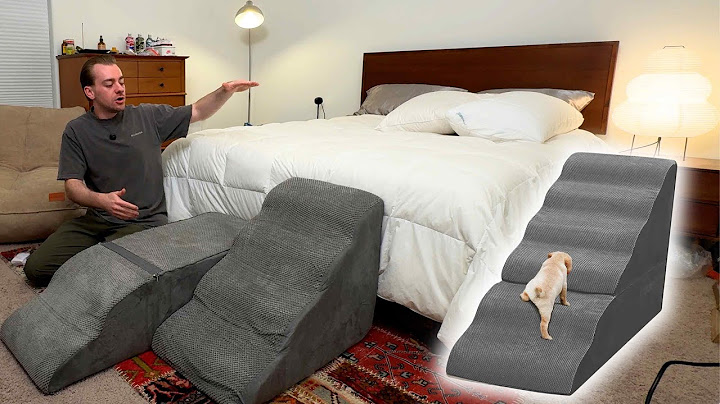
Write down the measurement in inches or centimeters and check how the product reports height. Manufacturers may list overall height, height to the top usable tread, or the height of a raised back edge. Those are not necessarily interchangeable. Ask for a diagram if the listing is ambiguous. A product described as 24 inches tall may place its last usable tread below the full measurement.
Also note whether the bed frame overhangs the mattress edge or creates a narrow lip. An accessible height is not useful if the dog must stretch across a gap to reach the sleeping surface. Keep hanging bedding away from the route so that it does not conceal the top platform or bunch under paws.
Calculate step count as a planning tool, not a prescription
For a simple idealized staircase, dividing total vertical rise by the number of equal rises gives an average rise per transition. That arithmetic helps compare advertised shapes; it does not establish what a dog should climb. Actual products may have different first and last risers, tapered foam steps, or a tall top platform.
| Illustrative mattress height | Equal rises | Arithmetic average rise |
| 24 inches | 4 | 6 inches |
| 28 inches | 5 | 5.6 inches |
| 30 inches | 6 | 5 inches |
These are hypothetical geometry examples only; none is a veterinary standard or a specific product recommendation. A six-rise design may demand much more floor space than a four-rise version. Larger treads and a less abrupt ascent can make the staircase longer, so every option must be checked in the room rather than by height alone.
Do not ignore tread depth and staircase length
An individual tread should provide usable space for the dog's paws, not just a decorative strip. Some compact stairs create the promised total rise by using steep transitions and short platforms. A dog may place two paws on the next step while its rear paws still occupy a lower one. In a long-bodied dog, that distance may be especially noticeable. Observe a calm gait on level ground and compare the stepping distance to the product's tread dimensions.
Measure the available run from the bedside outward. Add room for the dog to approach the first step without turning sharply and for household members to walk past. A staircase that fits the mathematical footprint but blocks the bedroom door is not practical. If the required footprint is larger than the room allows, shortening the stairs until they become steep may be the wrong compromise; explore lower furniture or another route.
Top-step alignment and the last movement
The highest tread should provide a stable transition to the mattress without requiring a substantial additional leap. Check where the dog's front paws will land and whether the mattress edge sinks when weight is applied. A loose bed skirt, thick quilt or protruding frame can interfere with footing. The dog should not have to rotate its body at the last instant to get around a nightstand.
Do not try to correct a height mismatch by stacking books, adding an unsecured riser under the stairs, or piling a cushion on the top tread. These improvised fixes can alter the base and weight distribution. A slight published dimension difference might still be workable for a particular dog, but judge the actual transition under calm supervision rather than assuming all gaps are harmless.
Select a structure that remains stable at height
As stairs rise higher, their center of mass and side-to-side behavior become important. Review the overall width, base length, frame joints, tread covering and the manufacturer's rated pet weight. A narrow tall unit can feel unstable when a dog steps near the edge even if it appears sturdy in a product photo. Light foam units may compress differently from a framed product, while folding models require engaged locks.
For material-specific comparisons, use foam dog steps or folding dog stairs. Neither category is automatically right for high beds. Confirm that the product is designed for indoor furniture and that its feet resist sliding on your floor. A bed on thick carpet and one on slick tile present different base-contact conditions.
A tall-bed fit audit you can perform before buying
Measure floor to the mattress top at the exact placement point.
Record free floor length and side clearance, including drawers and nightstands.
Note the dog's weight, body length, approach direction and comfort on ordinary steps.
Compare the manufacturer's top-tread height, individual rise, width, depth and unfolded footprint.
Check the published load rating and whether it applies to the assembled unit.
Decide where the dog will turn once it reaches the mattress and how it will descend.
Verify that the floor and base will not slide and that the unit can be inspected and cleaned.
This worksheet is more dependable than sorting listings by "extra tall." Save the actual measurements from each candidate so you can compare like for like. If an essential dimension is missing, request it from the seller instead of using the number of pictured steps to estimate size.
Teach access and watch the descent
Introduce the staircase without rushing. Reward approaches to the first tread and gradually build to a full climb if the dog seems comfortable. Observe the downhill route independently. Some dogs go up willingly but avoid descending, instead choosing to jump off the mattress. If that happens, block unsupervised bed access while you reassess the layout and training.
Be alert to slowing, trembling, slipping, refusal, or visible discomfort. A new reluctance to climb can reflect more than dislike of a product. A veterinarian can assess pain, orthopedic problems and potential neurologic signs. For a dog undergoing treatment for intervertebral disc disease, the recommendation may be no stair access at all during restricted activity, regardless of the product's advertised gentleness.
When to consider a ramp or lower furniture
A ramp replaces individual risers with a continuous walking surface, but rising to a high bed requires significant horizontal length to reduce steepness. A short ramp placed against a very tall mattress may be harder for the dog than expected. For slope, length and traction considerations, see canine ramps. In a small bedroom, moving the resting area to a lower surface may be more practical than either access product.
For a general indoor-stairs comparison, start with pet steps for bed. The high-bed question is narrower: can this dog comfortably complete the final transition at this exact height while the staircase stays secure? If the answer is uncertain, do not buy solely because the advertised number of steps matches your plan.
Mistakes that create poor high-bed access
A common mistake is measuring to the frame but forgetting the mattress thickness. Another is matching only total height while overlooking a top platform that ends lower than the listed measurement. Many shoppers also underestimate the footprint, then place the steps at an awkward angle next to the bed. Finally, a product with a large published weight rating can still have slick tread fabric or unstable feet on a particular floor.
Plan for the real room, not a clean product studio photo. Verify dimensions after delivery before allowing unsupervised use. Keep a return option available if the dog remains uncomfortable even after gentle practice. There is no value in keeping an unsuitable product simply because its advertised height looked perfect.
Frequently asked questions
How many stairs should a high dog bed have?
There is no universal count. More equal rises can reduce the arithmetic rise per step but increase the footprint. Compare the actual tread geometry with the bed height and the individual dog's mobility.
Is a 24-inch-tall stair suitable for a 24-inch bed?
Possibly, but only if 24 inches describes the top usable tread, not a decorative back or overall frame. Check the final gap, landing, weight rating and floor grip before deciding.
Can I raise pet stairs with a box underneath?
That is generally an unsafe shortcut unless the manufacturer explicitly specifies an engineered compatible platform. An improvised base can shift, tilt or defeat the stairs' stability design.
What if my dog climbs up but jumps down?
Treat descent as a separate training challenge. Supervise, reward calm downward steps and prevent unsupervised access while evaluating whether the design is comfortable in both directions.
Are high-bed stairs appropriate for a dog with IVDD?
Do not assume so. During an acute episode or recovery, activity restrictions can prohibit stair use. Ask the treating veterinarian about safe mobility and furniture access for that specific dog.