Evening Grosbeak: Field Marks, Range and Feeding
Evening Grosbeak: Field Marks, Range and Feeding Explore evidence-based facts, context and common misconceptions.
Evening Grosbeak: Field Marks, Range and Feeding
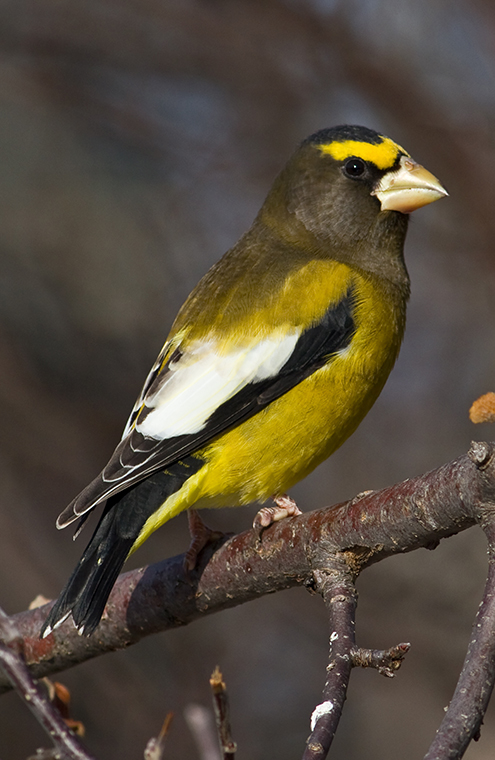
The Evening Grosbeak is a chunky finch with a powerful pale bill suited to cracking seeds. Adult males have strong yellow, black, and white patterning, while females and young birds show more muted grays and yellows.
The essentials
Its movements can be irregular: some winters bring notable southward appearances, while other years it may be scarce in the same locality. Seed crops, forest conditions, and food availability help shape these movements.
What makes this subject distinctive
The bird’s name does not mean it feeds only at dusk. It is active in daylight, and its large bill is useful for identifying it at feeders when plumage is difficult to see.
Food sources, safe nesting places, and movement between habitats influence where birds appear. A forest bird may visit a campsite, and a grassland bird may cross a suburb, but a brief encounter cannot establish its preferred year-round habitat. Regional field guides and dated sightings give important context.
Common misconceptions and limits
Numbers and distribution can change substantially between years. A winter influx should be interpreted as a movement event rather than immediate proof of a local breeding population.
Wild birds should be described as part of an ecosystem, not as pets whose behavior can be controlled. Habitat, season, and the age or sex of the animal can change the observations available to a field researcher. Good sources include regional bird atlases and field observations with dates.
How to check a field identification
Write down the location, date, approximate size, bill, posture, and main calls. A photograph can supplement these notes; it should not replace them when similar species share a color pattern. Look for multiple independent clues before settling on a name.
Key points at a glance
The Evening Grosbeak is a chunky finch with a powerful pale bill suited to cracking seeds.
Its movements can be irregular: some winters bring notable southward appearances, while other years it may be scarce in the same locality.
The bird’s name does not mean it feeds only at dusk.
Frequently asked questions
What is a useful first identification clue?
The Evening Grosbeak is a chunky finch with a powerful pale bill suited to cracking seeds.
Does appearance or behavior vary?
Its movements can be irregular: some winters bring notable southward appearances, while other years it may be scarce in the same locality.
What should be checked before making a broad claim?
Numbers and distribution can change substantially between years.
Explore related guides
A Field Guide to Wild Birds: Identification, Habitats, Behavior and Conservation
